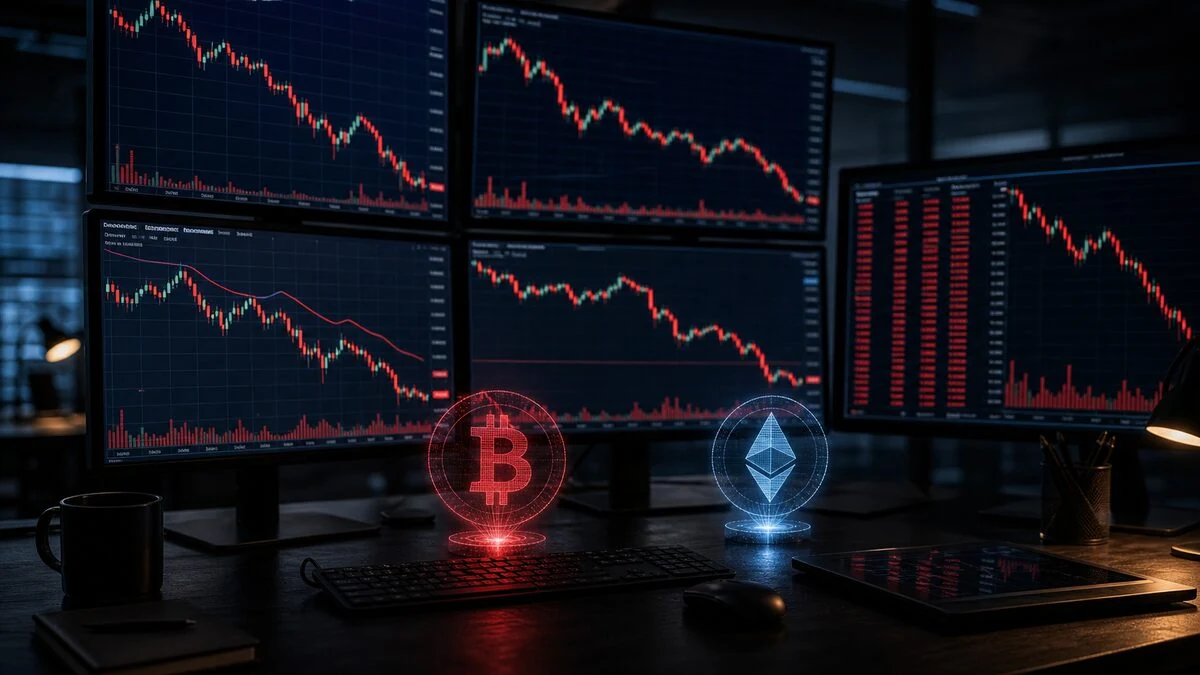
Crypto is having one of those sessions where every pressure point seems to arrive at once. CoinDesk reported that the market is on course for its worst week since July 2024, with bitcoin and ether near important support areas. Bitcoin ETF outflows and a broader capital rotation toward artificial intelligence infrastructure are also pulling attention away from digital assets.
The AI rotation matters because it gives traders a non-crypto explanation for why money is leaving. If funds are being raised, rebalanced, or sold to finance the AI infrastructure buildout, bitcoin can weaken even if long-term holders still believe in the asset. That is a different story from a pure crypto confidence crisis, but the price chart does not care about the reason in the short term.
For risk-management context, Patriotic Tech's share trading guide is useful background on why position sizing matters during fast moves. Today's Zcash security update also shows how one project-specific headline can spill into broader crypto sentiment.
The pressure stack
CoinDesk linked the latest weakness to a mix of bitcoin pressure, ether nearing support, Zcash stress after its Orchard vulnerability disclosure, and weakness around the AI trade. NewsBTC reported that spot Bitcoin ETFs saw outflows in 17 of the last 19 sessions, with a combined $5.6 billion leaving those products during that stretch. That kind of flow can turn a normal pullback into a market-wide mood shift.
The important thing is that these pressures reinforce each other. ETF outflows reduce passive support, security headlines make traders cut risk faster, and the AI infrastructure story gives institutions another place to put money. When those forces overlap, even long-term believers tend to wait for cleaner entries instead of catching every intraday bounce.
| Market pressure | Reported signal | Why traders care |
|---|---|---|
| Bitcoin support | BTC was reported near the low $60,000s. | A break below the round-number zone can trigger systematic selling and liquidations. |
| ETF outflows | NewsBTC cited 17 outflow days in 19 sessions. | ETF flows have become a quick read on institutional appetite. |
| AI capital rotation | AI infrastructure spending is absorbing large capital pools. | Investors may be funding AI exposure by reducing crypto risk. |
| Zcash shock | ZEC sold off after a critical privacy-pool bug disclosure. | Security headlines can drag risk appetite across the entire crypto board. |
None of this means bitcoin's long-term thesis has disappeared. It does mean the market is being forced to decide whether the current move is a temporary funding rotation or the beginning of a deeper deleveraging cycle. Those are very different outcomes.
What would calm the market
For bitcoin, the first sign of stabilization would be a clean defense of the support zone around the low $60,000s, followed by improving ETF flows. For ether, traders are watching whether buyers step in near the levels CoinDesk flagged as critical. For the broader market, Zcash's security story needs to stop spreading fear beyond ZEC itself.
The AI rotation is harder to measure because it is not a single wallet or a single fund. It is a macro story: capital markets are pouring money into chips, data centers, power contracts, and model companies. If that trade remains dominant, crypto may need a fresh catalyst to pull money back.
The takeaway
This is a classic stress test. Bitcoin is still the market's liquidity anchor, but even the anchor moves when flows reverse, leverage thins, and rival narratives become more attractive. Traders should be careful about treating every dip as the same kind of dip. A selloff caused by ETF outflows, security fear, and AI infrastructure funding deserves a wider lens than a normal weekend pullback.
The next few sessions will matter because support zones are not just lines on charts. They are places where buyers either prove there is real demand or step aside and let the market search lower. That makes volume, ETF flow data, and liquidation levels more useful than headline watching alone.