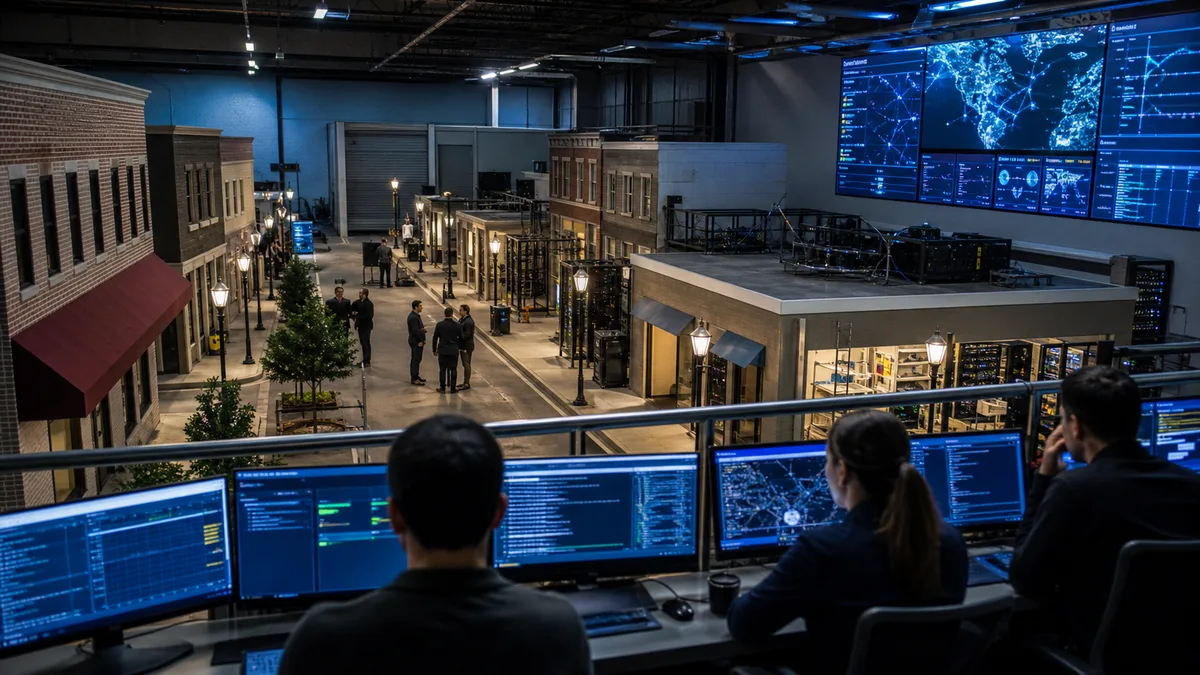
Cybersecurity training often happens in conference rooms, browser labs, or simulated dashboards. Those tools are useful, but they can flatten the messiness of real incidents. A cyberattack against a town, hospital, utility, or transportation system is not only a log-analysis problem. It involves people, physical equipment, emergency routines, public communication, and systems that were never designed to fail gracefully.
That is why a replica small town built for cyber training is a notable idea. It suggests a shift from abstract drills to realistic environments where defenders can see how digital compromise interacts with physical operations. When a simulated attack affects lights, doors, pumps, cameras, traffic systems, or business services, responders have to think across disciplines.
TechCrunch reported that the FBI built a replica small town in Alabama to simulate real-world cyberattacks. The concept is powerful because it treats cyber defense as something closer to emergency preparedness than ordinary IT troubleshooting.
The urgency is clear when paired with vulnerabilities like the one discussed in our Splunk Enterprise flaw coverage. Security tools, monitoring platforms, and infrastructure software can become part of the attack surface. Defenders need practice for situations where the systems they rely on are themselves under pressure.
Realistic training also exposes communication gaps. Engineers may understand the exploit but not the public impact. Executives may understand the risk but not the operational sequence. First responders may know the physical site but not the digital dependency. A good cyber range forces these groups to coordinate before a real incident makes coordination harder.
Critical infrastructure security is especially difficult because many environments mix modern software with older equipment. A water system, rail system, or municipal network may include devices that cannot be patched quickly, replaced cheaply, or taken offline casually. Training has to reflect that constraint. Perfect lab conditions are not enough when real systems are full of legacy assumptions.
The replica-town approach is a reminder that cyber resilience is learned through practice. Policies and tools matter, but teams also need muscle memory. The more connected everyday infrastructure becomes, the more cyber defense will resemble disaster response. Practicing in a realistic environment may be one of the few ways to make that response less chaotic when it counts.
The same thinking should spread beyond federal training. Utilities, hospitals, school districts, transit agencies, and regional governments need exercises that reflect their own equipment and constraints. A tabletop drill can reveal decision problems, but a realistic environment can reveal hidden dependencies. Which vendor must be called first? Which manual override still works? Which public message goes out if systems are down? Those questions are easier to answer before an incident. The replica town is valuable because it treats cyber defense as a practical operating skill, not only a technical specialty.
Realism also helps leadership make better funding decisions. It is easier to approve security investments after seeing how a simulated outage affects daily operations. A realistic range can turn abstract risk into a concrete sequence of failures, decisions, and recovery steps. That kind of experience often teaches more than another slide deck full of threat statistics.