SpaceX entering public trading is more than a market event. It is a test of whether investors now view orbital infrastructure with the same seriousness once reserved for cloud platforms, chip designers, and operating systems. The company opened at a scale rarely seen in any industry, and the early valuation instantly placed it among the largest listed technology names. That matters because SpaceX is not a pure software company with cheap marginal distribution. It builds rockets, satellites, ground systems, and manufacturing capacity, yet the market is treating that stack as strategic infrastructure.
The first-day numbers tell only part of the story. A huge listing gives employees and early investors liquidity, but it also exposes SpaceX to a new kind of pressure. Public markets reward growth, but they also demand cleaner disclosure, predictable margins, and a more legible path from ambition to earnings. SpaceX has several businesses that can be valued differently: launch services, Starlink broadband, government contracts, lunar and Mars-related projects, and potential data or compute services in orbit. The IPO forces those narratives into one public company.
The timing also lands during an AI infrastructure boom. Investors are already paying closer attention to power, networking, data centers, and alternative compute locations. SpaceX sits near that discussion because satellite networks can serve communications, defense, mapping, remote connectivity, and possibly future orbital compute experiments. We looked at that wider scarcity story in our coverage of AI capacity and space-linked infrastructure, and the same logic makes this listing feel larger than a conventional aerospace deal.
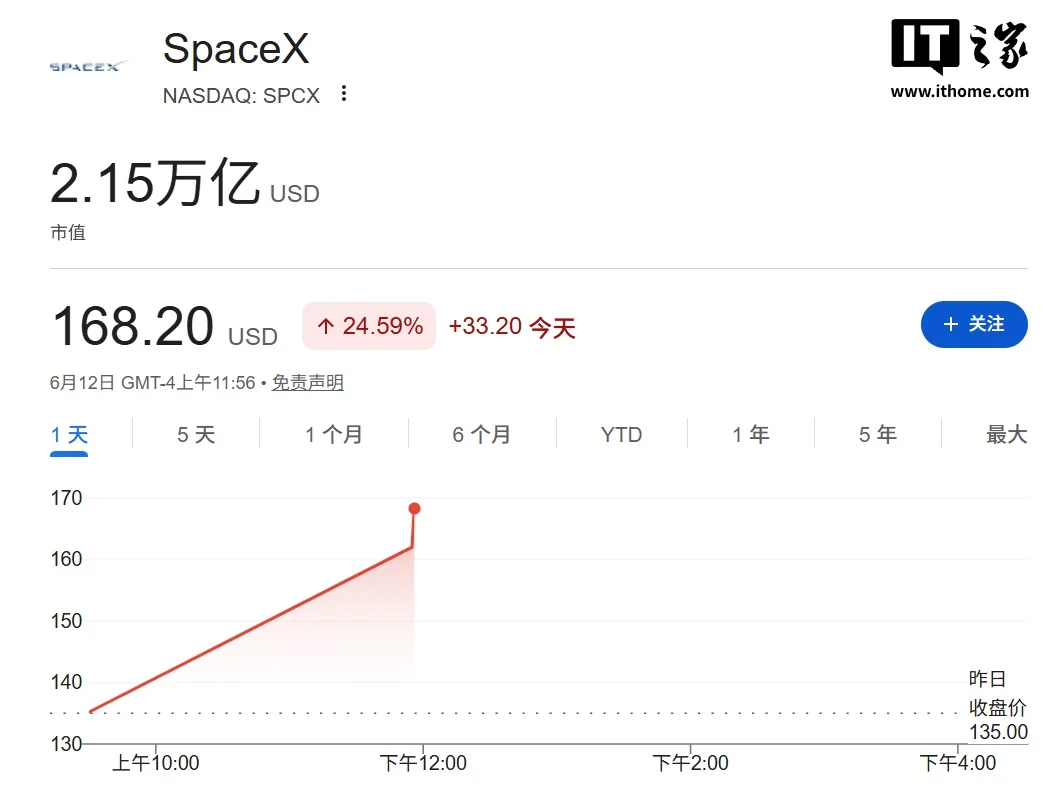
According to IT Home, SpaceX began trading on Nasdaq at $150 per share and quickly moved above $168, pushing its market value past $2.15 trillion. The report also says the company raised about $75 billion by selling roughly 555.6 million shares at an IPO price of $135, making it the largest IPO on record.
The new public valuation also changes the competitive frame for national space programs and private launch rivals. A company with public-market access at this scale can finance factories, reusable systems, and satellite deployment at a tempo smaller competitors cannot easily match. That does not remove technical risk. Rockets still fail, satellite regulation remains complicated, and Starlink faces local market and spectrum constraints. But a public equity currency gives SpaceX another lever alongside contracts and operating cash flow.
For the broader tech industry, the message is clear: infrastructure companies are back in fashion when they own a bottleneck. In the last decade, software margins made many hardware-heavy businesses look less attractive. Now AI demand, defense modernization, global connectivity, and compute scarcity have changed the lens. SpaceX is being valued as a platform because it controls launch, network deployment, and orbital operations. Whether the stock can justify that over time will depend less on first-day excitement and more on whether SpaceX can turn its engineering lead into durable, measurable cash generation.
There is also a governance angle that will become harder to ignore. SpaceX has been unusually founder-driven, and the report notes Musk still holds overwhelming voting control. Public shareholders may accept that while growth is strong, but a public listing changes the rhythm of questions around capital allocation, Starship timelines, Starlink margins, defense work, and regulatory exposure. The company has gained a larger capital market platform, but it has also moved into a more permanent spotlight.