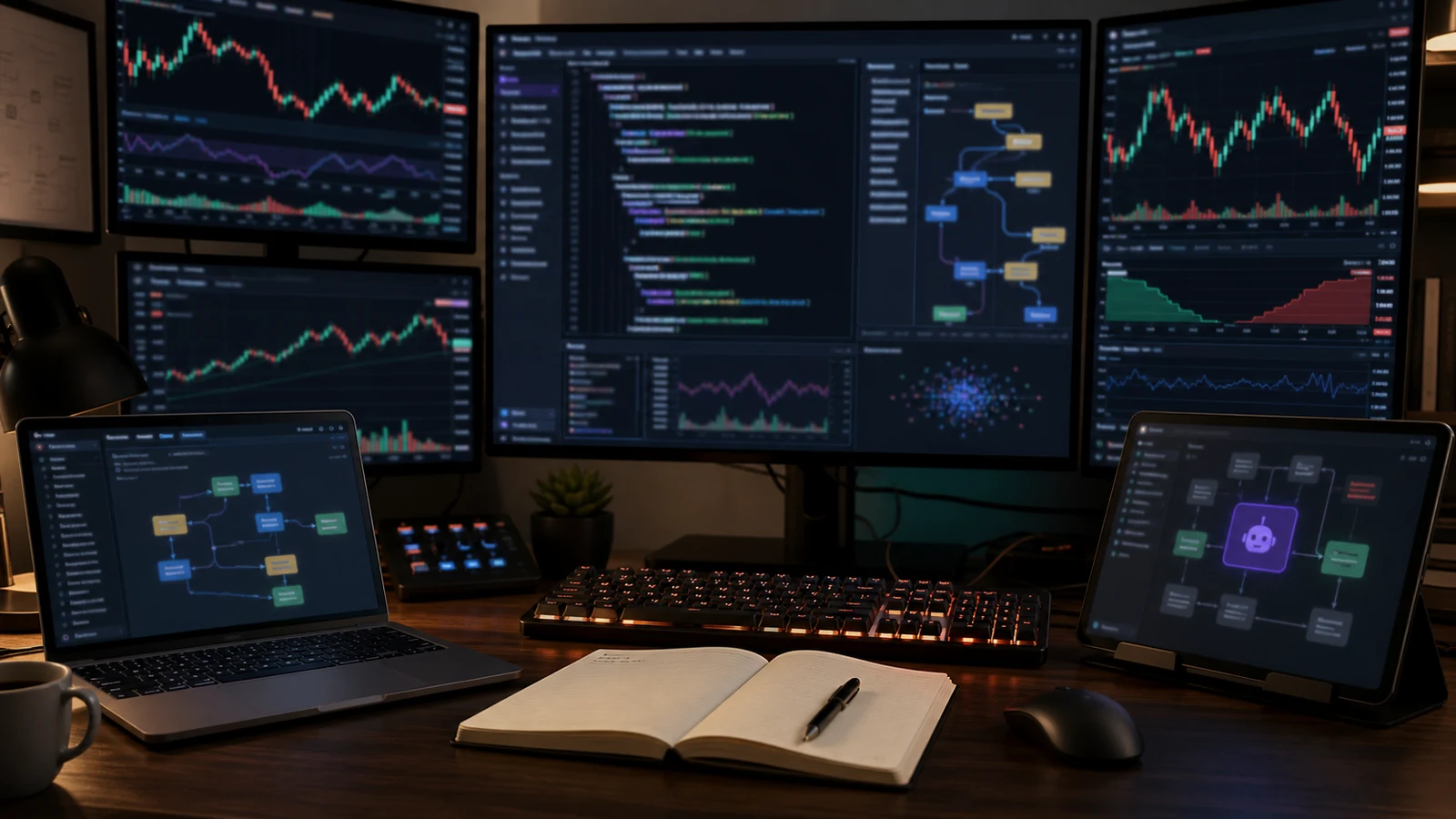
Day traders using AI tools to vibe code trading bots show how quickly automation has moved from professional desks to individual experimenters. The old barrier was technical skill. Building a bot required programming knowledge, market data handling, backtesting, and order routing. AI coding assistants lower that barrier by helping traders assemble scripts, strategies, dashboards, and alerts with far less manual coding.
That does not make the bots good. It makes them easier to build. The difference matters because financial markets punish bad assumptions quickly. A trader can generate a strategy that looks clever, run it on limited data, and mistake a lucky backtest for an edge. AI makes the construction faster, but it does not remove market risk.
For basic discipline, Patriotic Tech's share trading strategies guide remains relevant. Position sizing, stop discipline, liquidity, and risk management still matter when the trade is suggested by a bot. Automation does not make a weak trading plan strong.
The new risk is confidence
AI-generated code can create a dangerous feeling of competence. A bot with a clean dashboard and technical indicators may look professional even if the logic is fragile. It may fail during volatile conditions, ignore transaction costs, mishandle missing data, or trade too aggressively after a string of wins. Those are ordinary trading mistakes with a faster engine attached.
Retail traders also need to think about brokerage rules, API limits, tax records, and whether a strategy behaves differently in live markets than it does in simulation. A bot that performs well on historical candles may break when spreads widen or orders partially fill. AI assistants can help write the code, but they cannot guarantee execution quality.
The healthier use case is augmentation. Traders can use AI to summarize news, generate research checklists, clean data, write small scripts, test hypotheses, or document strategy rules. Letting an unproven bot make autonomous trades is a much bigger leap. The difference between assistant and trader should remain clear.
Vibe coding will keep spreading because it is useful. The challenge is that finance is not a normal software playground. A bug in a hobby app may be annoying. A bug in a trading bot can become a real loss before the user understands what happened.
There is a community effect too. Traders share screenshots, prompts, snippets, and performance claims online, and AI makes those ideas easier to copy. That can create crowded strategies quickly. A signal that worked for one person in one market regime may degrade when many people chase it or when conditions change. New bot builders should treat every shared strategy as a hypothesis, not a recipe. They need paper trading, out-of-sample testing, drawdown limits, and logs that explain why the bot entered or exited. The code may be generated in minutes, but the discipline around it still has to be earned slowly.
Brokerage platforms may eventually respond with safer sandboxes, stricter API warnings, and built-in simulation tools. The retail trend described by Business Insider makes that response feel more likely, because traders need a way to experiment without connecting every AI-generated idea directly to live capital.