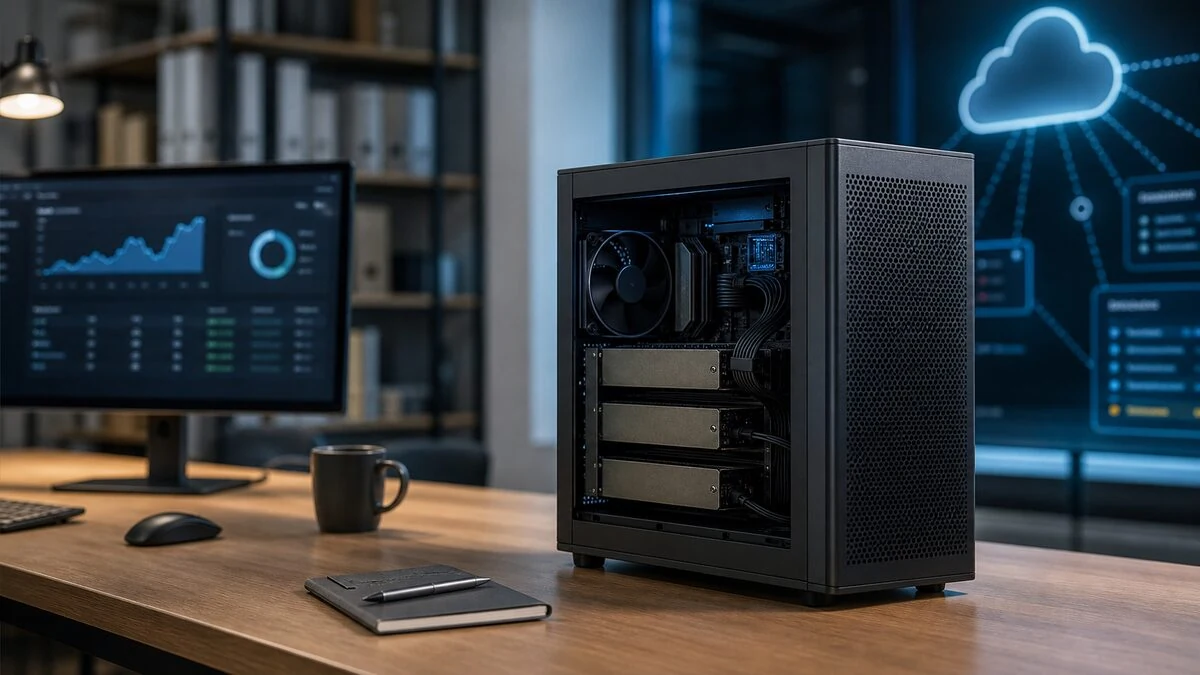
AI infrastructure debates often start with GPUs, but agentic systems make CPUs important again. Agents do not only run one big inference call. They plan, retrieve, call tools, execute code, validate outputs, manage state, and coordinate many smaller operations. That orchestration can put heavy pressure on general-purpose compute.
This is why cloud CPU efficiency matters in the agentic AI era. If every agent step triggers databases, APIs, containers, queues, and policy checks, the economics of the surrounding system can become just as important as the accelerator bill. A cheap model call can still produce an expensive workflow if the orchestration layer is inefficient.
Custom Arm server CPUs are attractive because hyperscalers can tune hardware, virtualization, networking, and pricing together. The processor is not sold as a standalone object. It is part of a cloud service that includes instances, storage, security, observability, and procurement simplicity.
The Next Platform reported that AWS has tuned Graviton5 for agentic AI and improved the bang for the buck. The report places CPU performance inside a larger cloud economics story, which is the correct frame for agent workloads.
That efficiency question is tied to the data center build-out discussed in our Data4 700MW AI campus story. When AI facilities reach industrial scale, the cost of every watt, core, memory channel, and network hop matters. Efficient CPUs can reduce waste around accelerator-heavy systems.
Developers should also think about architecture. Agents that spawn too many steps, duplicate context, or call expensive tools unnecessarily will waste whatever hardware they run on. Better CPUs help, but they do not replace good workflow design, caching, batching, and observability.
There is a competitive angle for traditional CPU vendors. If hyperscalers can make their own Arm chips the default for AI orchestration, AMD and Intel must prove value beyond raw benchmark leadership. They need platform stories around memory, security, compatibility, and power efficiency that matter inside cloud workloads.
Graviton5's agentic AI positioning shows that the CPU story is not over. GPUs may grab the spotlight, but agents live inside distributed systems. The companies that make those systems cheaper and easier to run will shape how quickly enterprise AI moves from experiments into production.
The agentic AI cost problem is especially subtle because waste can hide inside successful demos. A prototype may work beautifully with a handful of users, then become expensive when thousands of agents repeat unnecessary planning steps or pull the same context over and over. CPUs like Graviton5 can improve the price-performance envelope, but teams still need measurement at the workflow level. They should track tool calls, token use, retries, latency, cache hits, and compute consumed outside the model endpoint. The future cloud winners will not only sell faster chips. They will help customers understand why an agent costs what it costs every time it acts.
That makes Graviton5 part of a broader cloud design argument. The best agent stacks will match each task to the cheapest reliable compute tier instead of treating every AI action as a premium workload.