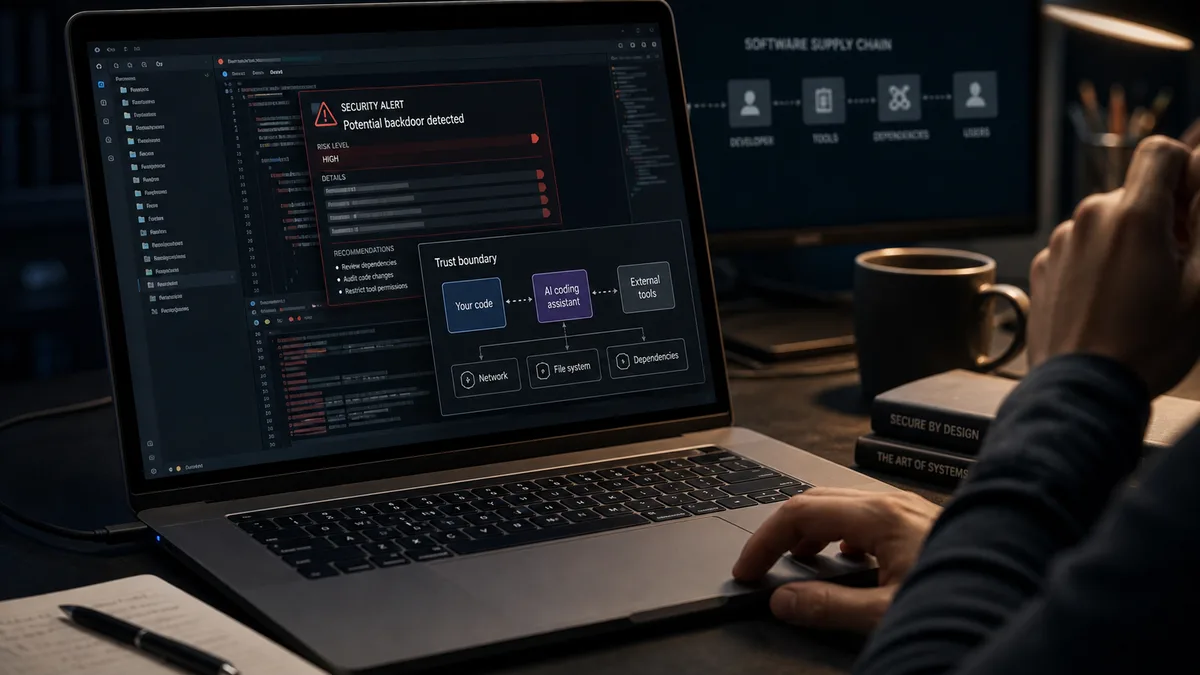
AI coding tools are useful because they move quickly. That is also why they are dangerous when they trust the wrong thing. A new security demonstration involving Claude Code shows how an agent can run hidden malware from a repository without verifying what is happening first. The lesson is not that coding agents are unusable. The lesson is that speed cannot replace suspicion.
The risk sits in a familiar developer habit: clone a repository, install dependencies, run setup, and start exploring. Humans already make mistakes in that chain, but an AI agent can automate the mistake faster and with more confidence. We have warned about similar issues in AI developer tooling needing stronger guardrails, especially when tools can read files, execute commands, or connect to services.
The Decoder reports on research from Mozilla's 0DIN platform showing how a compromised GitHub repository can take control when an AI coding tool runs its setup. The important detail is that the malicious behavior is not obvious from a quick glance and can be triggered dynamically.
This kind of attack is especially worrying because coding agents often operate inside valuable environments. They may have access to source code, environment variables, package credentials, SSH keys, cloud tokens, or internal documentation. A compromised setup step can turn a helpful assistant into an attacker with local privileges.
The fix is not a single warning banner. Agents need execution policies, repository trust levels, sandboxing, dependency inspection, network restrictions, and clear user approval before running unfamiliar commands. They should be able to explain why a command is needed and what files it will touch before it executes.
Teams also need to change habits. If developers let agents operate in production-like folders with secrets loaded, the blast radius is too large. A safer workflow uses disposable worktrees, minimal credentials, package lock inspection, and clean containers for unknown code.
AI coding assistants will keep improving, but security cannot be treated as a later feature. The more capable the agent becomes, the more valuable its mistakes become to attackers. This test is a useful warning because it shows the gap while teams still have time to tighten their workflows.
The uncomfortable truth is that many developers want agents to be bold. They ask tools to set up projects, install packages, run tests, and fix errors without stopping every minute. Security design has to respect that workflow instead of simply blocking everything. A better agent should separate low-risk file reading from high-risk execution, summarize suspicious scripts, and escalate only the actions that could change the machine or expose credentials.
Repository reputation may become part of the agent interface. A tool could warn when a repo is new, has unusual install hooks, fetches code from dynamic domains, or contains obfuscated setup behavior. Humans already miss those signals when tired. Agents can help if they are trained to be cautious by default rather than optimized only to complete the task quickly.
This is exactly where enterprise policies will become stricter. Teams may allow agents to edit code but block package installation, network calls, or shell execution until a human approves. That may sound slower, but it mirrors how companies already handle production deployments. AI coding tools need to fit mature security practice instead of asking security teams to trust them because the demo looked impressive.