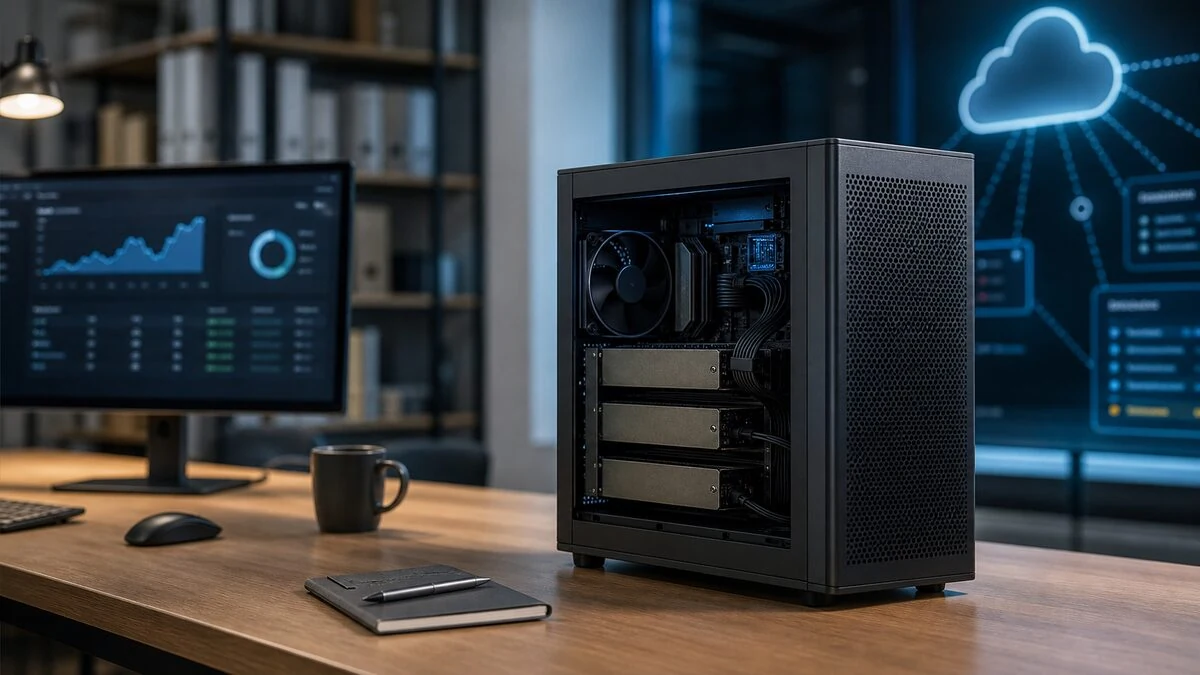
Dell is making the case that not every agentic AI workload has to live in public cloud. ITPro reports that Dell unveiled Deskside Agentic AI at Dell Technologies World 2026 as part of Dell AI Factory with Nvidia. The product is described as a secure local sandbox for building, testing, running, and fine-tuning AI agents on high-performance workstations.
The pitch is straightforward: some companies want the benefits of agentic AI without sending sensitive data or every token request to a public cloud API. Dell is positioning local workstations as a way to control cost, protect data, and let developers experiment with always-on agents in a more governed environment.
That argument fits the themes in our private AI cloud versus public AI cloud guide. It also connects to our AI cloud infrastructure article, because organizations are now comparing rented accelerators, local workstations, private clusters, and managed AI services more seriously.
Why local AI hardware is back in the conversation
For years, the easy answer was to send demanding AI work to cloud services. That still makes sense for many teams. But agentic workflows can be token-hungry, long-running, and deeply connected to internal code, documents, and systems. The more an agent touches sensitive workflows, the more enterprises ask where that work should run.
| Deployment option | Best fit | Concern |
|---|---|---|
| Public AI API | Fast access to top models and scale. | Variable cost and data-control questions. |
| Deskside workstation | Local agent testing and sensitive workflows. | Hardware management and model limits. |
| Private AI cluster | Shared enterprise AI platform. | Higher complexity and capital planning. |
| Hybrid AI | Mix of local and cloud execution. | Policy and routing decisions must be clear. |
Dell's claim around cost savings versus public cloud APIs is the part buyers will scrutinize most. Local hardware can be cheaper for steady, heavy usage, but cloud can be better for bursty workloads or access to the most capable frontier models. The correct answer depends on how often agents run, what models are needed, how sensitive the data is, and how much internal IT can support.
The developer experience will decide whether the idea works. If local agents are difficult to install, update, monitor, or connect to enterprise data, teams will fall back to cloud APIs because they are easier. Dell needs the workstation to feel like a managed development environment, not a science project that only one specialist can maintain.
The practical takeaway
Deskside AI workstations will not replace public cloud AI. They will sit beside it. Developers may test agents locally, run sensitive workflows on controlled machines, and still use cloud models when they need frontier capability or elastic scale. That hybrid pattern is likely to become normal.
Security policy should come first. Local AI systems can still leak data through logs, copied prompts, exported model outputs, weak access controls, or unmanaged plugins. A workstation under a desk is not automatically safer than cloud. It is safer only when it is patched, monitored, encrypted, and governed like the serious infrastructure it is becoming.
The buying question is whether a local AI workstation solves a real workflow. If the answer is yes, it can reduce friction and surprise token bills. If the answer is vague, it becomes another expensive box under a desk. Dell's launch is interesting because it forces that conversation into the open.