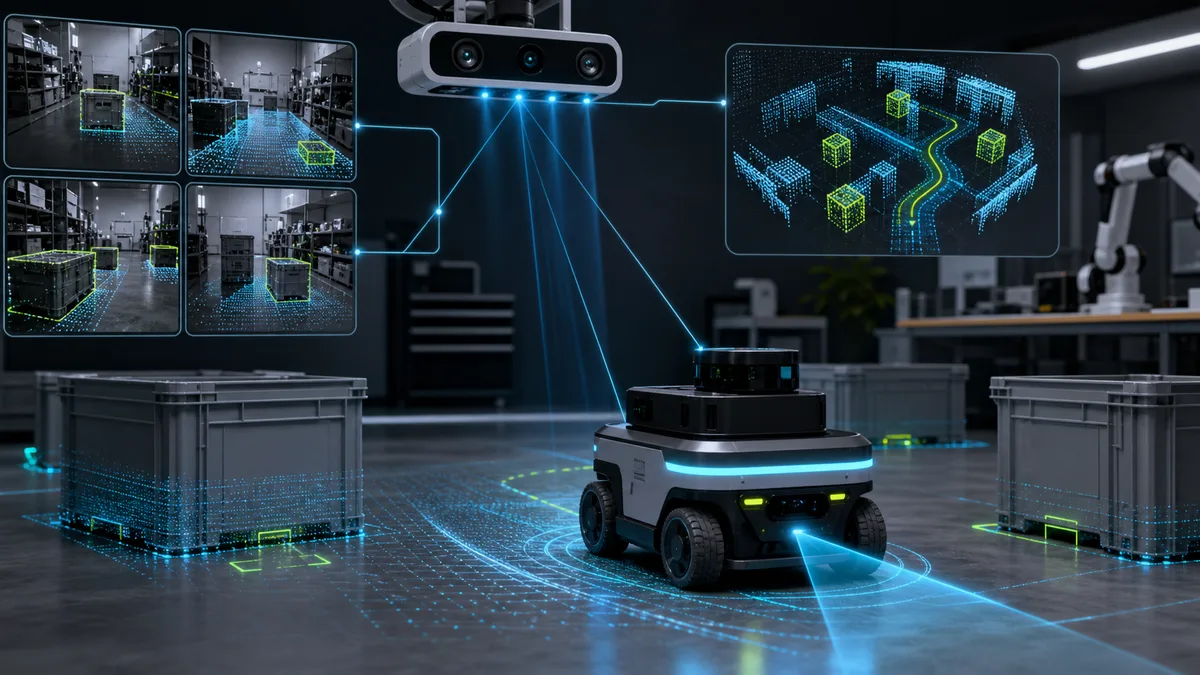
Om AI's VLX model launch is notable because it focuses on continuous perception rather than static image understanding. Robots, cameras, and edge devices do not experience the world as neat screenshots. They receive changing video, sound, movement, and location cues. A real-time multimodal model has to process that stream quickly enough for the device to act while the scene is still relevant.
That is a different problem from analyzing an uploaded clip after the fact. Edge robots need low latency, efficient memory use, and reliable behavior when network conditions are poor. If a model can keep a running understanding of the environment and update its decisions incrementally, it becomes much more useful for navigation, inspection, following, and assistance.
TOM reported in Chinese that Om AI released the VLX model series, describing it as a streaming multimodal architecture for the physical world. The article points to a three-part structure around perception, localization, and action.
We have covered similar embodied-AI pressure in physical AI robot benchmark analysis. The hard part is no longer only recognizing objects. It is connecting perception to motion in a world where timing, uncertainty, and safety all matter.
The edge angle is important. Cloud AI can be powerful, but robots cannot wait for a distant server every time they need to avoid an obstacle or follow a person through a doorway. Local inference reduces latency and improves resilience. It also creates hardware constraints, because smaller devices have limited power, heat capacity, and memory.
The model still has to prove itself outside launch claims. Real-time multimodal systems need testing in messy lighting, crowded rooms, reflective surfaces, moving people, and unpredictable routes. A model that works in a controlled demo may struggle when deployed in a warehouse, hospital, store, or home.
Even with that caution, the launch points in the right direction. AI is moving from answering questions to perceiving and acting. VLX is part of a broader industry shift toward models that understand the physical world as a live stream. That is where robotics will either become practical or remain trapped in impressive demos.
Developers will also care about deployment shape. A model for physical AI has to fit into cameras, robots, drones, or industrial boxes without demanding a data-center budget. If VLX can scale down while keeping useful perception, it becomes more than a research announcement. It becomes a building block for products that need to react in real time.
The product ecosystem around the model will matter too. Robotics companies need documentation, reference hardware, simulation tools, safety guidance, and ways to fine-tune for specific environments. A model release without that support can impress researchers but frustrate builders. If Om AI wants VLX to become a platform, it needs to make adoption predictable for teams that are not model specialists but still need reliable perception.
Safety cases will decide adoption in serious environments. A robot that perceives continuously must also know when confidence is low, when to stop, and when to ask for help. Real-time perception is exciting, but hesitation can be a feature. In physical AI, a cautious pause is often better than a confident mistake.