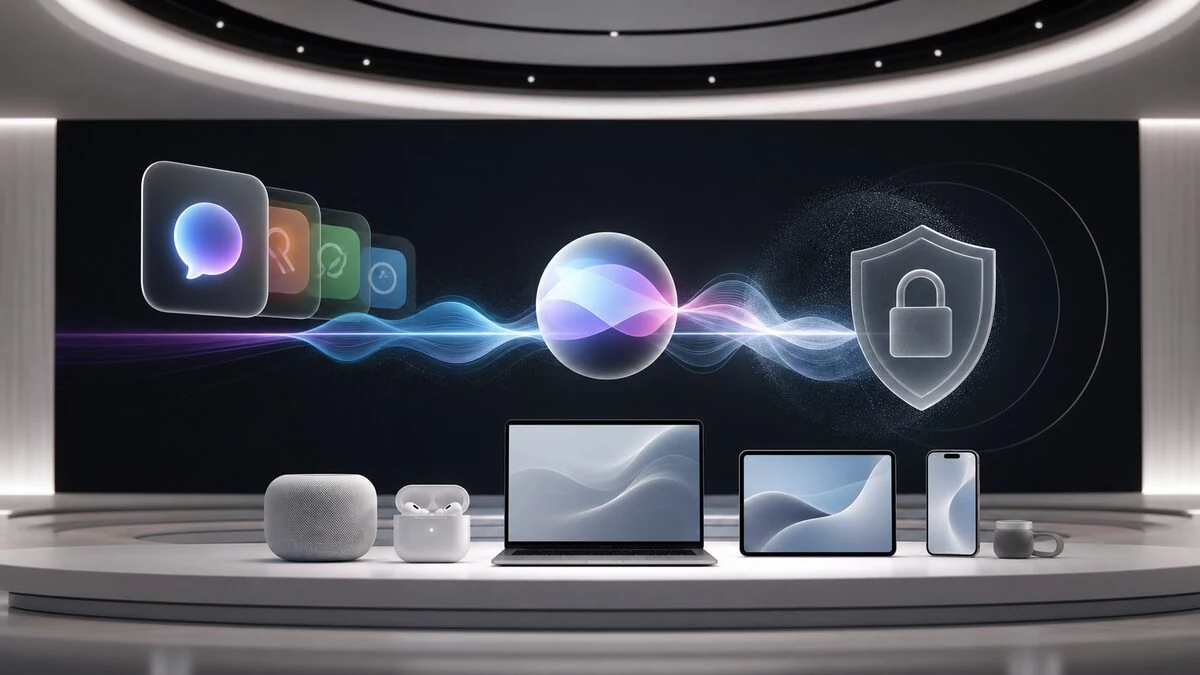
Apple's WWDC 2026 AI message did not land as a clean win with investors. Investor's Business Daily reported that Apple shares slipped after the company's AI strategy reveal, with analysts weighing a careful Siri AI rollout, regional limitations, and the possibility that some broader assistant capabilities may arrive later than the market hoped.
The reaction shows how different the investor standard has become. A few years ago, an Apple software keynote could rely on polish, ecosystem features, and device loyalty. In the AI cycle, investors want evidence that Apple can turn its installed base into a meaningful AI advantage. That means timing, capability, infrastructure, device eligibility, and user adoption all matter.
What Wall Street is measuring
Apple's AI challenge is not simply that competitors moved earlier. It is that Apple's business model leaves less room for half-finished experiences. A rough chatbot can improve weekly on the web. An iPhone assistant that disappoints becomes part of a premium hardware experience. That makes Apple cautious, but markets may read caution as lost momentum.
| Investor question | Why it matters | Apple's challenge |
|---|---|---|
| When will Siri AI scale? | Delayed features reduce excitement. | Ship reliability without another promise gap. |
| Which devices qualify? | AI features can drive upgrades. | Avoid making too many users feel excluded. |
| How much is cloud-based? | Infrastructure cost affects margins. | Balance privacy, latency, and compute demand. |
| Can AI change revenue? | Investors want more than feature parity. | Turn assistant value into retention or upgrades. |
The regional issue matters too. If certain AI capabilities are unavailable in the European Union or China at launch, Apple's addressable user base for the full experience shrinks. That does not destroy the strategy, but it complicates the story. Apple is global, and AI features that vary by market make the product harder to explain.
Apple still has advantages. Its devices are personal, its ecosystem is sticky, and its users already perform countless tasks through native apps. If Siri AI can safely understand context across messages, photos, calendar, maps, and documents, Apple can make AI feel less like a separate chatbot and more like a useful layer inside the phone. That is a powerful position if executed well.
The problem is that investors have heard versions of the Siri story before. They want proof that the assistant is finally moving beyond simple commands and inconsistent answers. Demonstrations are no longer enough. Shipping dates, supported devices, language availability, and real user behavior will decide whether sentiment improves.
Developers are another audience Apple has to convince. If Apple wants richer AI actions across apps, third-party developers need clear APIs, privacy rules, and monetization logic. A smarter Siri will be less impressive if it only works deeply inside Apple's own apps while the rest of the ecosystem waits for guidance.
The WWDC reaction should be read as impatience, not rejection. Wall Street is not saying Apple cannot compete in AI. It is saying the company has to show more than tasteful restraint. In this market, careful promises need visible delivery. Apple has the distribution to matter quickly, but only if the new Siri becomes something people actually use.