Mini PCs used to be treated as compromise machines: useful for signage, kiosks, light office work, or home labs, but rarely central to serious enterprise computing. That view is becoming outdated. As laptop-class CPUs gain better integrated graphics, NPUs, media engines, and efficiency controls, compact boxes can handle workloads that once required larger desktops.
Panther Lake systems are part of that shift. A small PC can now serve as an edge node, a developer workstation, a conference-room compute device, a lab controller, or a low-power server for local applications. The appeal is not just size. It is the combination of compute, thermals, ports, and manageability in a package that can be deployed almost anywhere.
The enterprise angle matters because AI is spreading beyond the data center. Companies may need local inference, vision processing, data collection, and device control near the source of activity. A compact system can be easier to deploy at branches, factories, hospitals, and retail sites than a full server.
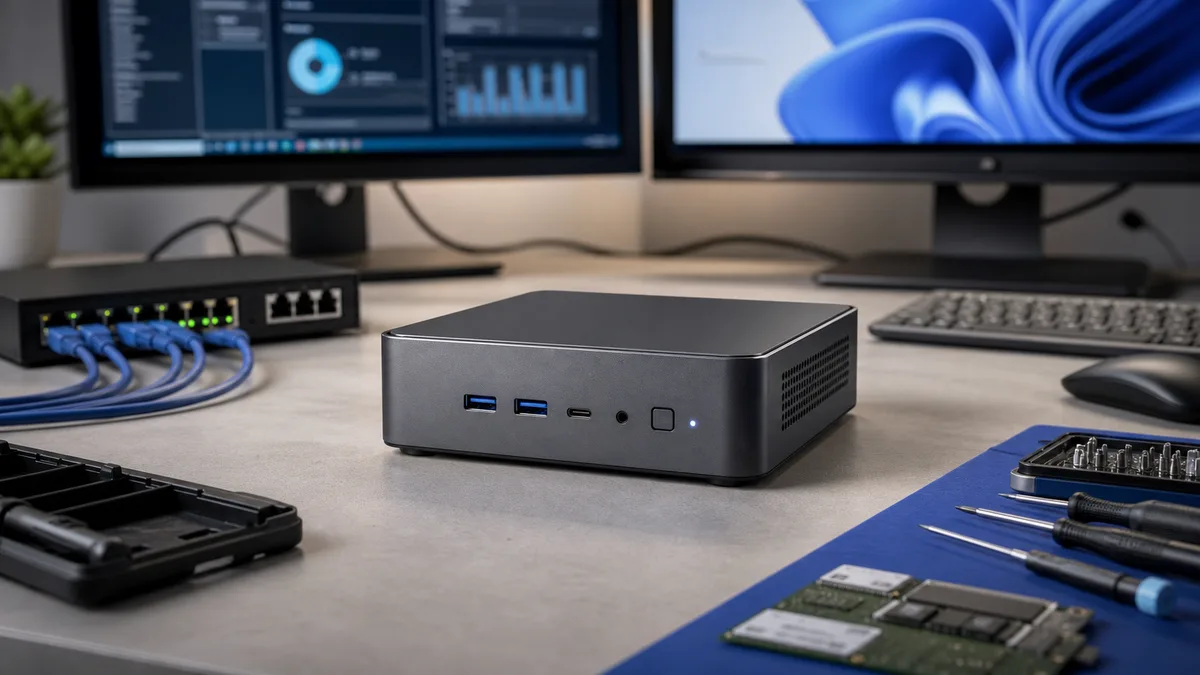
ServeTheHome reviewed the ASRock Industrial NUC BOX-358H and framed it as a Panther Lake mini PC that marks a major change for the line. That review context is useful because it treats the device as infrastructure, not just a small consumer desktop.
Software support is just as important as the hardware, which is why the mini PC story connects with our Linux 7.2 kernel safety coverage. Compact systems depend on reliable drivers, power management, networking, and kernel-level hardware support. Without that foundation, the hardware potential is wasted.
The buying decision will depend on I/O as much as CPU speed. Enterprises need ports for displays, storage, networking, sensors, and sometimes industrial interfaces. A powerful chip inside a sealed box is less useful if the system cannot connect to the real environment it is supposed to manage.
Thermals are another test. Small systems can post impressive benchmark bursts, but sustained performance matters more in edge and office deployments. The best mini PCs will be the ones that deliver predictable behavior under continuous load without becoming loud, hot, or unreliable.
The Panther Lake mini PC category shows how enterprise computing is spreading outward. Not every workload needs a rack, and not every AI task needs a giant accelerator. Sometimes the strategic machine is the small box that can sit close to people, sensors, and business processes while quietly doing useful work.
Mini PCs also fit a procurement gap between laptops and servers. A laptop is portable but not ideal for fixed operational tasks. A rack server is powerful but often too large, loud, and expensive for small sites. A well-built mini PC can sit quietly near equipment, run local services, and be replaced or upgraded without redesigning the whole environment. That makes it attractive for edge AI pilots, branch-office automation, and lightweight virtualization. The category will still need strong remote management and long lifecycle support to win enterprise trust. If vendors provide that, small systems could become a surprisingly important part of distributed computing fleets.
That is why this class of hardware deserves attention from IT teams, not only enthusiasts. Small systems are becoming credible building blocks for places where a full server would be excessive.