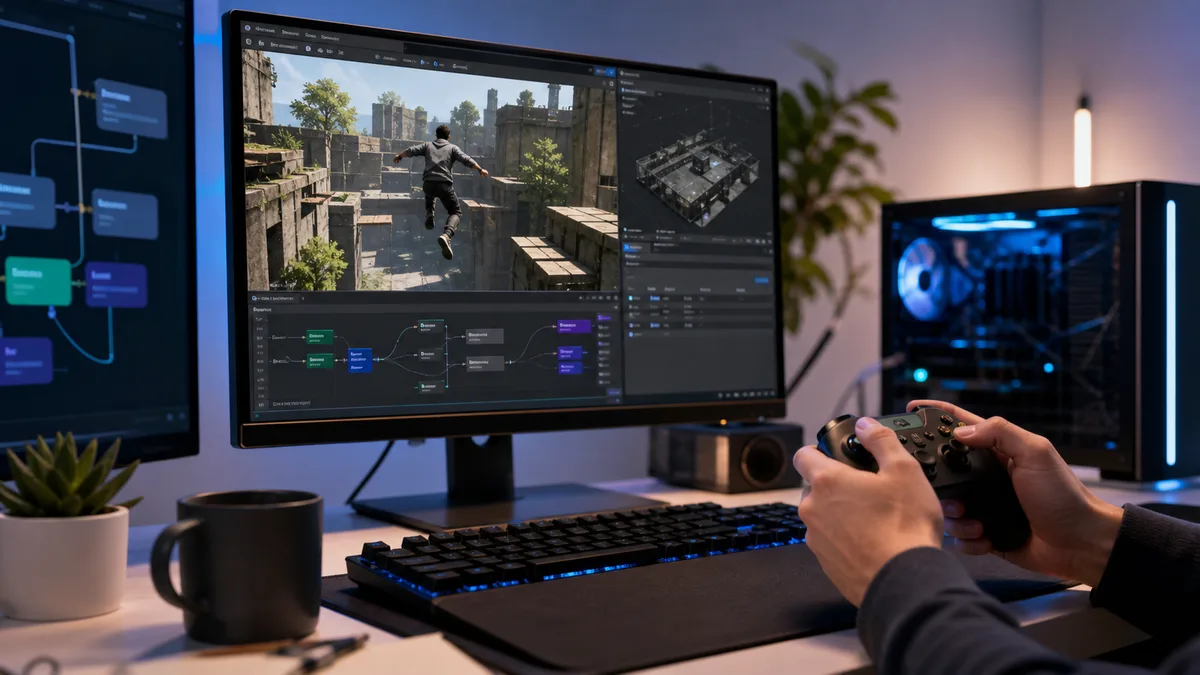
Tencent's Hunyuan Hy3 launch is interesting because it pushes generative AI closer to interactive 3D work rather than static images or short clips. If a model can help produce game-ready scenes, characters, or simple playable prototypes, it changes how quickly teams can test ideas.
The bigger point is not that AI will replace game development. It is that early visual exploration, layout blocking, asset variation, and prototype building could become faster. Small teams spend huge amounts of time just reaching the point where an idea can be judged on screen.
This connects with our earlier article on prompt-based game creation. The market is clearly moving toward tools that let people describe a playable concept and then refine it with less manual setup.
cnBeta covered the Hunyuan Hy3 release as part of Tencent's wider AI model push. The Chinese-language report is useful because Tencent's domestic developer ecosystem may become one of the first places where this kind of 3D generation is tested at scale.
The technical challenge is much harder than making a pretty render. Games need geometry that behaves, animations that connect, collisions that make sense, textures that remain consistent, and assets that can be edited inside real engines.
For developers, the dream is speed without chaos. A useful model would create rough scenes, enemy variations, props, and simple mechanics while still letting artists and designers cleanly adjust the result.
For Tencent, the advantage is distribution. A company with games, cloud services, AI labs, and developer tools can connect model output to actual workflows faster than a lab that only publishes demos.
There are still quality and rights questions. Generated 3D assets must avoid copying protected designs, and studios need provenance tools before they place AI-made content into commercial games.
The next signal to watch is engine integration. If Hy3 output can move cleanly into Unity, Unreal, or Tencent's own pipelines, the model becomes more than a launch headline.
The education market could benefit too. Students learning game design often struggle to connect concept, art, code, and level structure. A 3D generation tool that creates editable rough drafts could let beginners study why a scene works, then replace generated parts with their own craft as they improve.
Professional studios will be more cautious. They need predictable asset ownership, version control, performance budgets, and a pipeline that does not create cleanup debt. Hy3 becomes more convincing if it supports that serious workflow rather than only producing impressive standalone samples.
User control will separate toys from tools. A developer should be able to lock a character, change the environment, adjust rules, and regenerate only one part of the scene. If each prompt rewrites the whole project unpredictably, the model may be fun for demos but exhausting for production.
Tencent's advantage is that it can test this idea with real creator behavior, not only lab feedback. If users repeatedly ask for the same edits after generation, that data can shape the next model and make Hy3 more useful for practical game prototyping.
The launch shows that AI generation is becoming more spatial and interactive. That is a meaningful shift because the next creative bottleneck is not only making pixels, but making usable worlds.