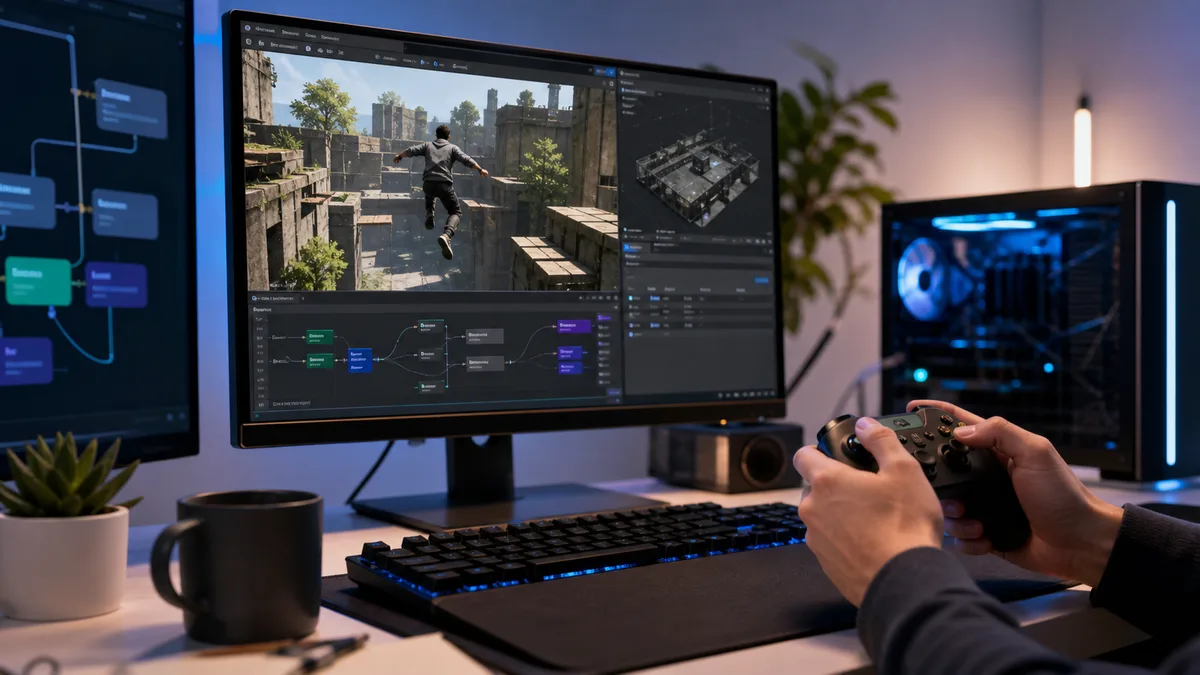
The Hunyuan Hy3 report about generating a 3D runner-style game in minutes turns Tencent's model launch into a practical product test. A demo that produces something playable is much easier to judge than a model card full of abstract claims.
Fast generation matters because game ideas are cheap and prototypes are expensive. Designers often need to test camera feel, movement, obstacle spacing, visual style, and loop timing before they know whether an idea deserves more work.
It connects with our earlier look at Hunyuan Hy3's 3D generation push. The model story becomes stronger when separate Chinese sources describe not only the release, but the kind of output Tencent wants users to imagine.
钛媒体 framed the report around Tencent rebuilding momentum and showing a five-minute generation example. That detail matters because speed is the selling point, but the product will live or die on editability after the first output appears.
A five-minute game is not the same as a finished game. The generated project still needs tuning, asset cleanup, collision checks, performance work, difficulty balance, sound, menus, and publishing support.
For small studios and solo creators, the value could be early exploration. Instead of spending days assembling a rough prototype, they could generate several directions and then choose which one deserves human craft.
For Tencent, Hy3 could become a bridge between AI research, cloud services, game tooling, and creator platforms. That combination is stronger than a model released into the void.
The risk is sameness. If many users start from the same generated patterns, the output could feel generic unless the tool supports deep customization and clean export into professional workflows.
The next signal to watch is whether developers can inspect the generated assets and logic rather than receive a sealed demo. Real tools need editable parts.
The real test is iteration after generation. A creator should be able to say that the jump is too floaty, the camera is too low, the obstacles are too dense, or the art style should be colder, and the system should update the right parts without breaking everything else.
Distribution will matter too. If Tencent connects generated prototypes to social sharing, cloud play, or lightweight publishing, Hy3 could become a creativity funnel rather than only a developer tool. That would raise moderation and originality questions, but it would also make the model easier for non-specialists to try.
Game feel is the hardest part to automate. A runner can look complete and still feel dull if acceleration, rhythm, hit boxes, and reward timing are wrong. Hy3's strongest future would combine fast generation with controls that help designers tune those invisible details after the first build appears.
The report is most persuasive when read as a workflow claim. Tencent is not only saying that a model can make assets; it is suggesting that an idea can move from prompt to playable draft while the creative spark is still fresh.
The report makes AI game generation feel less theoretical. The question is no longer whether a model can produce a quick scene, but whether it can produce a starting point that human creators actually want to keep.