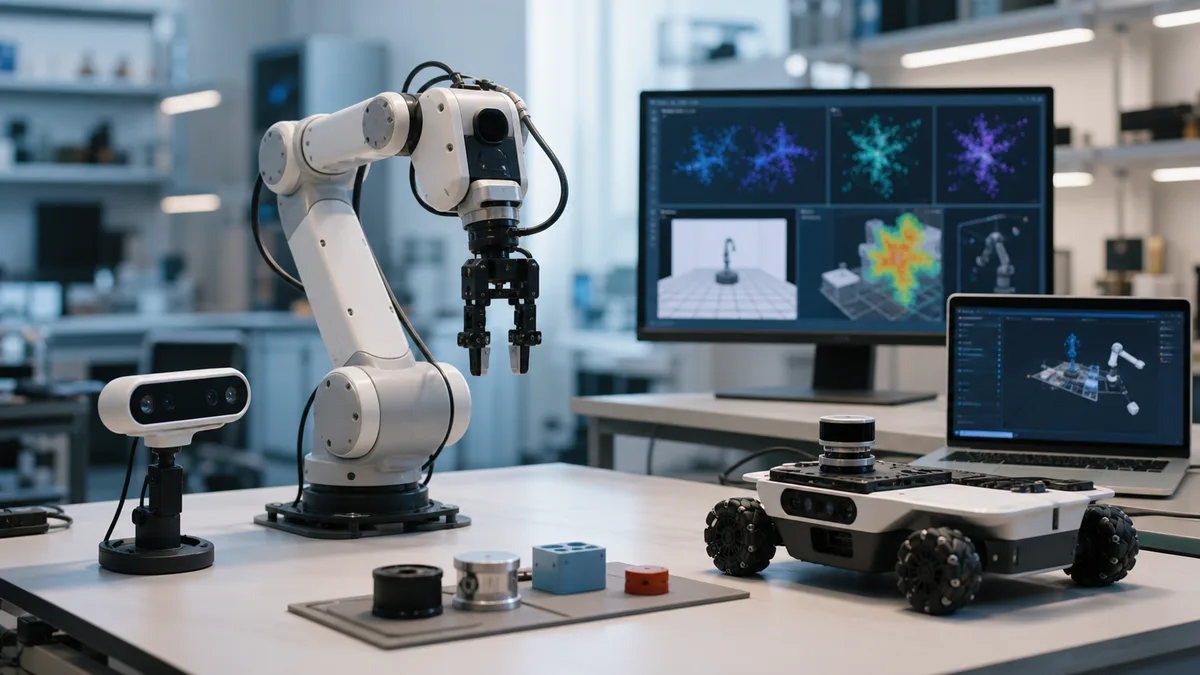
The ACE-Brain model report from Chinese tech media is worth watching because embodied AI is starting to look less like isolated robot demos and more like a model-building race. The field needs systems that understand space, movement, language, and task intent at the same time.
Robotics has always been harder than chatbot AI because the world pushes back. A robot has to see, move, grasp, avoid, recover, and operate safely when conditions are imperfect. A model that claims progress across embodied tasks therefore deserves careful attention, not instant hype.
The story pairs with our coverage of humanoid robotics market momentum. Capital, open models, and hardware platforms are starting to move together, which makes the software layer more important.
雷峰网 reported ACE-Brain-0.5 as an open unified embodied foundation model with strong benchmark claims. The key part is the open angle, because robotics research advances faster when labs can inspect, test, and adapt shared systems instead of only watching closed demos.
The technical promise is a model that can support different embodied tasks without being rebuilt from scratch each time. That could help with navigation, manipulation, planning, and multi-step instructions across robots or simulated environments.
For developers, open embodied models can reduce the cost of experimentation. A university lab, startup, or robotics team can build from a stronger base, then spend more effort on data, safety, hardware adaptation, and real-world reliability.
The hard part remains transfer. A model that performs well in simulation or controlled benchmarks may still struggle with lighting, clutter, uneven floors, weird objects, and human unpredictability.
China's robotics ecosystem gives this report extra weight. There are many hardware teams, fast iteration cycles, and a market hungry for factory, logistics, service, and humanoid applications.
The next signal to watch is reproduction. If outside teams can run ACE-Brain, compare its performance, and improve it on real robots, the release becomes meaningful beyond the announcement.
Open embodied AI also helps expose weaknesses. When more teams can test a model, they find failure cases that the original lab may not see. That is especially important for robots because a model that succeeds in one room can fail badly when lighting, floors, tools, or human behavior change.
The commercial path will likely begin in bounded environments. Warehouses, inspection routes, factory cells, and lab automation are easier to structure than open homes or busy streets. If ACE-Brain-style models improve those controlled tasks first, the progress can still be meaningful without pretending general-purpose robots are already solved.
Data will remain the bottleneck. Robots need experience with physical variation, but collecting that experience is slower and more expensive than scraping text. Open models can help, yet embodied AI still needs shared datasets, simulation quality, and careful safety testing before broad deployment becomes realistic.
The open-source claim also gives hardware startups a reason to experiment sooner. A robotics team that cannot train a foundation model from scratch may still adapt an open base model to its grippers, sensors, and target environment.
Embodied AI is moving from impressive videos toward reusable infrastructure. ACE-Brain matters because open model work could decide who gets to experiment widely, not only who can afford the largest private robotics lab.