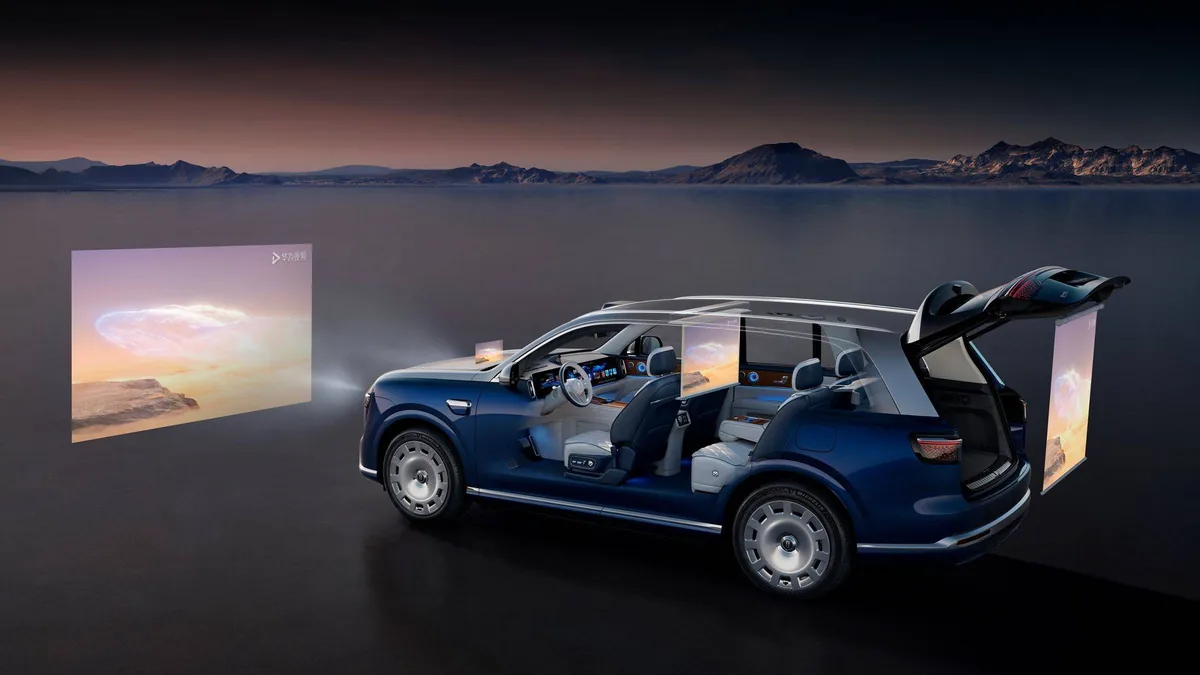
A car roof patent sounds like a small design filing until it is placed inside the modern EV cabin race. Automakers are no longer competing only on range and acceleration. They are competing on what the inside of the vehicle feels like when the car is charging, parked, navigating, or being used as a family space. A roof that can store or support projection hardware fits directly into that shift.
Huawei's role makes the report more interesting. The company has become a major technology partner in China's smart-car market, especially around cabin software, sensors, displays, and assisted driving systems. A roof projection concept would not just be decorative. It could become part of an entertainment, meeting, navigation, or rear-seat experience if paired with the right software and display surface.
The cabin is becoming a platform. Screens are spreading across dashboards, rear seats, mirrors, and control panels, but too many screens can make a car feel cluttered. A retractable or hidden projection surface could offer a larger display only when needed. That idea connects with our earlier coverage of a Huawei automotive patent leak, where software-defined vehicle features were already moving beyond traditional controls.
According to 搜狐网, a Huawei vehicle roof appearance patent involving Yu Chengdong shows a design that could store a projection curtain or related hardware. A patent does not guarantee a production car, but it is a useful window into what Huawei and its partners may be exploring for future smart cabins.
The practical challenge is packaging. A vehicle roof already has structural, safety, lighting, airbag, antenna, and panoramic glass considerations. Adding projection hardware means managing heat, weight, durability, and crash safety. It also has to work across different lighting conditions. A projector-style cabin feature sounds attractive in a dark parked car, but daytime visibility and motion comfort are harder problems.
There is a user-behavior question too. Drivers should not be distracted by entertainment features, and passengers may not always want the cabin turned into a theater. The best version would be context-aware: useful while parked, charging, camping, or waiting, but restrained while driving. Smart EV features need good boundaries as much as clever hardware.
Huawei's advantage is that it can integrate cabin ideas with phones, apps, voice assistants, and vehicle software. If a roof projection feature exists only as a hardware trick, it may fade quickly. If it connects to navigation previews, video calls, presentations, family entertainment, or assisted-driving status displays in a controlled way, it could become part of a broader smart mobility experience.
The patent report is not proof that a Huawei-backed car will soon arrive with a ceiling projector. It does show how far the EV cabin competition has moved. The next wave of smart-car features may hide in places that used to be passive surfaces. Roofs, doors, seats, and windows are becoming interface territory, and Huawei appears to be exploring that territory aggressively.
The idea could also appeal to automakers trying to make charging stops feel less like waiting. If a parked EV can become a comfortable media or work space for twenty minutes, cabin technology becomes part of the charging experience. That is a subtle but important shift as electric vehicles compete on more than driving range.