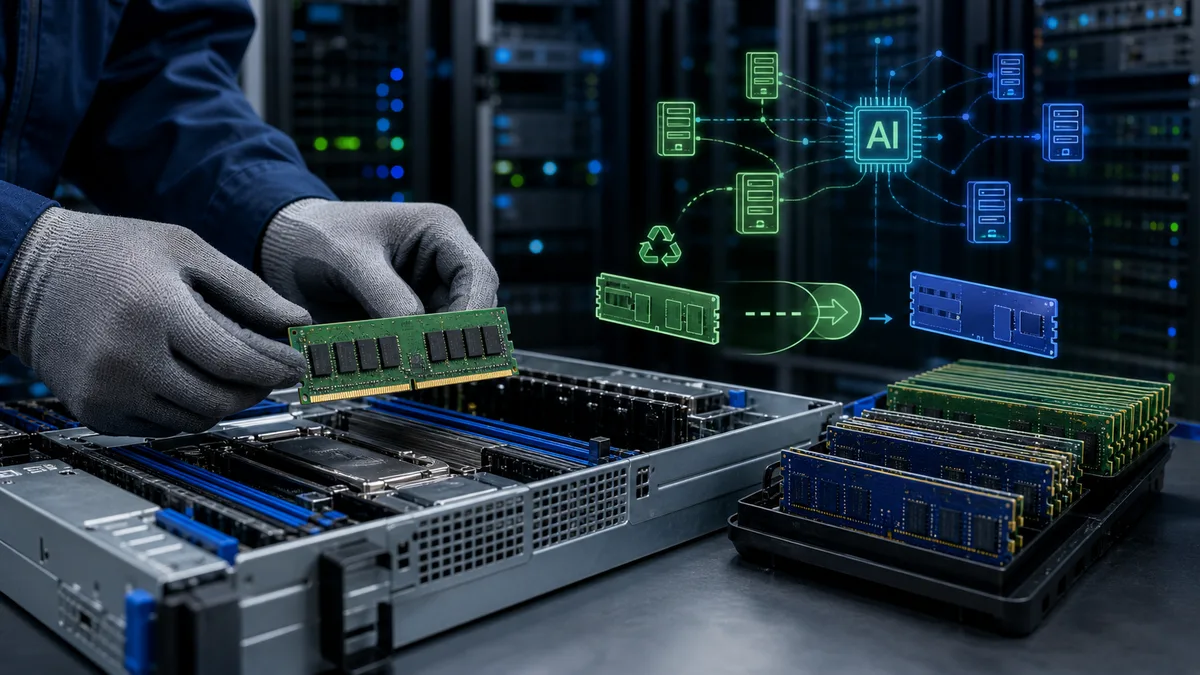
Meta's reported work on reusing dismantled DDR4 memory beside newer DDR5 systems is exactly the kind of infrastructure story that shows where AI economics are heading. The public conversation often focuses on frontier model demos, but the operational battle is about inference cost, server utilization, power, and hardware reuse. When a company the size of Meta looks for memory savings, the pressure is not theoretical.
AI inference is relentless because every user request has a cost. Training gets the headlines, but serving models at scale is the recurring bill. If older memory can be redeployed safely in new server designs, it may reduce waste and delay some fresh hardware purchases. That is not glamorous, but it can matter enormously when fleets are measured in thousands of machines.
Chinese coverage from IT Home describes Meta's Vistara-related memory reuse direction, including a reported mix of DDR5 and DDR4 to reduce the amount of new server hardware required for AI inference. The story came through Chinese-language reporting, but the infrastructure issue is global.
We have covered the broader hardware squeeze in AI chip volume pressure. Compute is not only about GPUs. Memory, packaging, networking, cooling, and power all become constraints when demand keeps rising faster than data centers can expand.
The engineering challenge is reliability. Reused memory cannot become a hidden failure source inside inference fleets. Meta would need careful validation, error monitoring, performance modeling, and maintenance planning. A clever reuse strategy only works if it does not create outages or unpredictable latency that customers experience as slow AI.
There is also an environmental angle. AI infrastructure is under scrutiny for energy and hardware consumption. Reusing components will not solve power demand, but it can reduce waste and make better use of parts that still have service life. That matters when companies are trying to defend massive data-center expansion to regulators and communities.
The report is important because it shows AI scaling entering a more practical phase. Companies are no longer only asking how to make models bigger. They are asking how to serve them cheaper, longer, and with less waste. That is where the next infrastructure competition may be won.
This kind of optimization may become a competitive advantage. If two companies can serve similar model quality but one can reuse hardware, reduce memory waste, and defer new server purchases, its economics improve. AI winners may not only be the companies with the smartest researchers. They may also be the companies with the most disciplined infrastructure engineering.
It also hints at a future where AI infrastructure teams borrow more ideas from circular hardware programs. Components may be graded, repurposed, and assigned to workloads based on risk and performance needs. Not every inference job requires the newest memory. If companies can match hardware quality to workload carefully, they may reduce both spending and waste. That is a practical engineering discipline, not a slogan.
The approach may also shape procurement. If infrastructure teams know that future server designs can reuse certain components, they may buy and retire hardware differently. That long view matters at Meta scale. Hardware strategy becomes less about individual refresh cycles and more about keeping useful parts in circulation across multiple AI workloads.