Metal 3D printing is already valuable for complex shapes, but the next step is controlling material behavior more precisely during the print itself. If a printer can influence how metals mix, cool, and solidify, additive manufacturing becomes more than shape-making. It becomes a way to engineer material properties inside a part.
The idea of alloys on demand is powerful because many industries need parts with different properties in different regions. Aerospace, medical devices, energy systems, and industrial tooling all care about strength, weight, heat resistance, fatigue, and corrosion. A single material is not always the best answer for every part of a component.
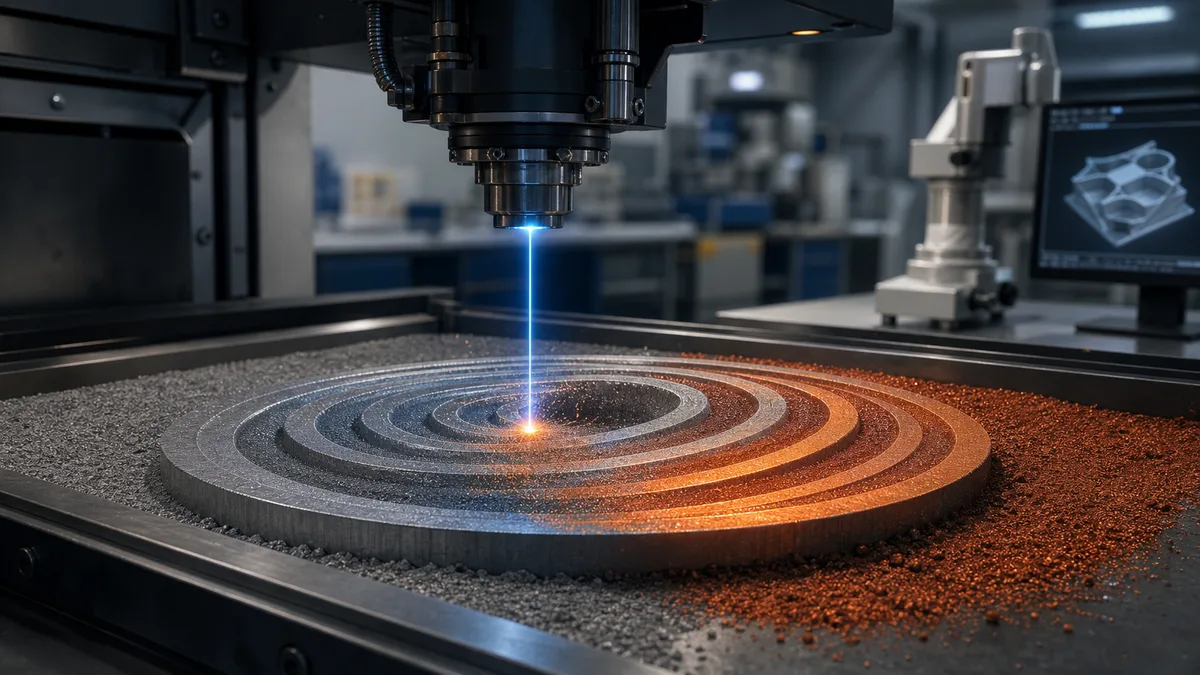
Changing laser motion may sound like a small process adjustment, but it can have large effects. In powder-bed printing, the laser controls the melt pool. Its path, speed, power, and timing influence how material flows and solidifies. Better control can reduce defects and make more complex alloy behavior possible.
Tom's Hardware reported that NIST demonstrated a metal 3D printing method that uses looping elliptical laser paths to stir molten metal and create alloys during fabrication. The key practical point is that existing machinery may be able to implement the approach through software changes.
That manufacturing angle connects with our Imec quantum silicon article. In both cases, the future depends on process control. Whether building qubit systems or advanced metal parts, better tools are only useful when the manufacturing method is repeatable.
The software-upgrade possibility is especially interesting. If existing printers can gain new alloy control without total hardware replacement, adoption becomes more realistic. Manufacturers are more likely to test a method that fits into current capital equipment than one that requires a complete new production line.
There will still be qualification hurdles. Industries that use metal 3D printed parts often require strict testing and certification. A new process must prove that it can produce consistent properties across batches, geometries, and machines. Material innovation moves slowly when safety matters.
The NIST work shows how advanced manufacturing is becoming more software-defined. The laser path is not just a tool movement. It is a material-control instruction. If that idea scales, 3D printing could shift from making unusual shapes to making parts whose internal material behavior is designed as carefully as their geometry.
There is also a useful lesson for factories that are cautious about additive manufacturing. The most persuasive advances are not always new machines with futuristic branding. Sometimes they are process refinements that make existing equipment more capable and more predictable. If laser-path control can be validated across materials and machines, it could give manufacturers a lower-risk way to experiment with graded alloys and stronger parts. That matters because industrial buyers rarely adopt a technology just because it is clever. They adopt it when it improves a part, fits a workflow, and can be certified without turning production planning into a research project.
The most interesting outcome would be wider design freedom without wider production chaos. If material control becomes software-adjustable, engineers can explore stronger parts while still using familiar factory tools.