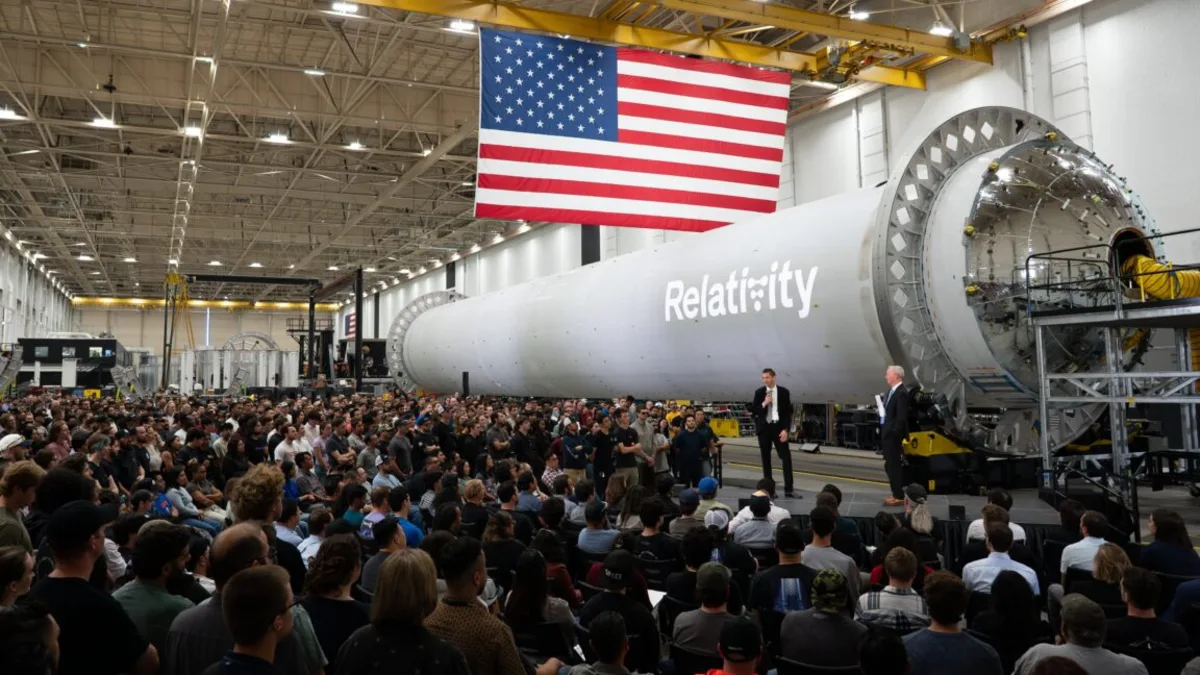
Commercial space can look mature from a distance. Rockets launch regularly, satellite internet has become a consumer product, and private companies talk about Mars with the confidence that airlines discuss routes. Up close, the industry is still unsettled. Launch pads are rebuilt, new rockets slip, vehicle names change, and ambitious timelines keep colliding with hardware reality.
That tension is what makes the latest space industry roundup interesting. Blue Origin's launch infrastructure is moving through recovery work, Relativity Space is tying its future to a Mars mission narrative, and European launch startups are still trying to prove they can fly reliably. None of those developments is isolated. They show a sector where money, talent, national strategy, and technical uncertainty are all moving at the same time.
Relativity is especially worth watching because it has moved beyond its early identity as a 3D-printed rocket company. The company has been trying to position Terran R as a more serious medium-to-heavy launch vehicle, and Mars gives that roadmap a dramatic destination. The question is whether the mission story can stay aligned with near-term execution. Space companies win trust by flying, not by having the best pitch deck.
Ars Technica covered the mix of launch pad rebuilding, Relativity's Mars target, and other rocket industry updates. The recurring theme is that private space remains an engineering business first. A single delay, fluid-system issue, or pad problem can reset schedules regardless of investor enthusiasm.
The public-market side of space has been getting louder too, as we noted in our look at space technology becoming public-market infrastructure. Investors are no longer treating rockets only as scientific spectacle. They are asking how launch capacity supports satellites, data services, defense needs, imaging, connectivity, and AI infrastructure in orbit.
That broader demand creates opportunity for new launch providers, but it also raises the penalty for overpromising. Customers want schedule certainty. Governments want strategic capacity. Satellite companies want pricing power and reliability. A launcher that misses its first windows can still recover, but the market is less patient when payload plans depend on specific orbital dates.
Blue Origin's pad work also reminds us that space infrastructure is as important as the rocket itself. A vehicle cannot create cadence without ground systems, manufacturing flow, range coordination, fuel handling, and fast repair cycles. SpaceX's biggest advantage has never been only booster design. It has been the ability to turn launches into an operating rhythm. Rivals are still trying to build that rhythm.
The latest updates do not point to a quiet industry. They point to one that is still experimenting with business models, mission claims, and hardware at once. That restlessness is risky, but it is also why space technology keeps producing new competitors. The winners will be the companies that turn big stories into repeatable flights before the market gets tired of waiting.
For customers, the signal to watch is not the boldest destination. It is cadence. A company that can manufacture, launch, learn, and return to the pad predictably will earn more trust than one with the most dramatic mission art. Mars ambitions can inspire teams, but operational rhythm is what turns space technology into a real market.