Storage is becoming part of the AI hardware conversation, and that is a bigger deal than it sounds. A fast processor or GPU can only do so much if local data moves slowly. As more users run AI tools on workstations, gaming laptops, creator PCs, and edge devices, SSD controllers are starting to matter in a new way.
The latest Chinese electronics coverage around a PCIe Gen5 SSD controller points directly at that shift. PCIe Gen5 storage is not only about quicker file copies. It can help with large model files, local datasets, video caches, development builds, and creative workloads that bounce constantly between memory, storage, and accelerators. In a local AI workflow, waiting on storage can become a hidden bottleneck.
This matters for gadgets because AI is moving from cloud-only demos into real devices. Laptops, mini PCs, NAS systems, external drives, and even some future mobile workstations will need storage designed for high sustained throughput, thermal stability, and predictable latency. A fast headline speed is useful, but consistency is what professionals feel.
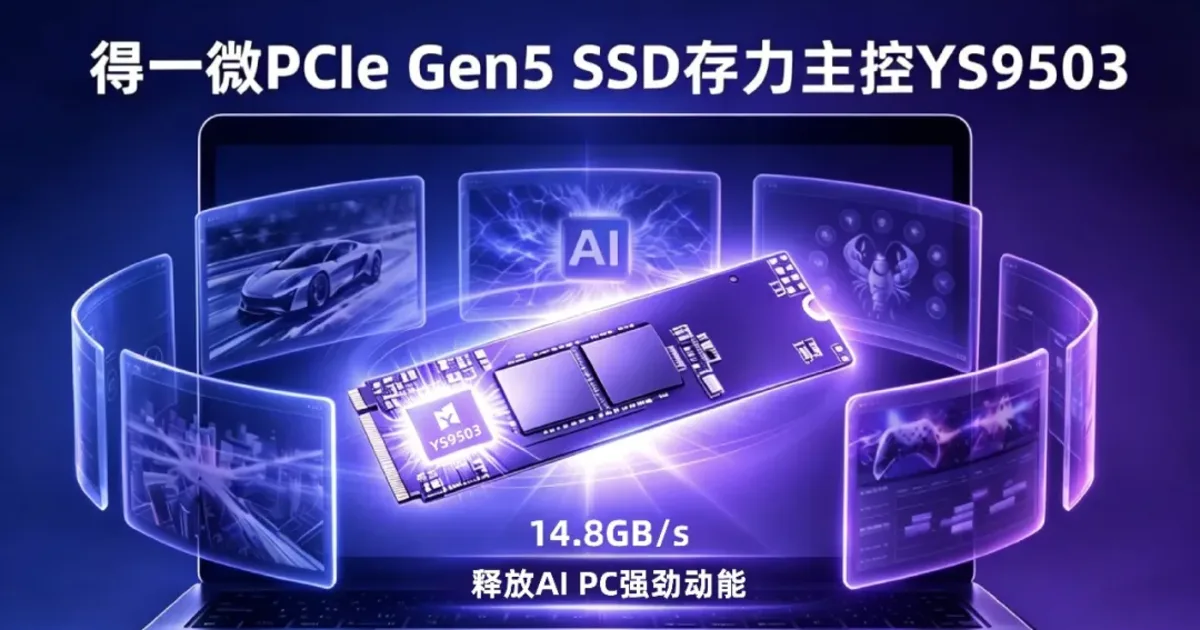
电子发烧友 covered a PCIe Gen5 SSD controller from Deyiwei shown around COMPUTEX 2026, describing an AI storage architecture aimed at edge and local AI applications. The report highlights how controller-level design is being tied to device-side AI workloads.
This connects closely with our look at RTX Spark local AI PCs. Local AI is not only a GPU story. It is a system story involving memory, storage, thermals, software, power, and data movement. Storage vendors are now trying to claim a stronger role in that stack.
The consumer benefit may arrive indirectly. Better SSD controllers can make high-end laptops feel faster when handling big projects, but they can also improve reliability for creators and developers who work with large files every day. If controller makers optimize for sustained AI workloads, future drives may be less likely to slow down under heat or long sessions.
There is also a power angle. AI-capable portable devices cannot simply run storage at maximum draw all the time. Controllers need smarter power states and efficient scheduling so a laptop can remain responsive without draining the battery. That may become a selling point as local AI features become common in mainstream PCs.
The news is technical, but the direction is easy to understand. Fast storage is no longer a background component. It is becoming part of how devices run AI locally, edit media, load games, and keep massive app libraries responsive. The next generation of gadgets may depend on SSD intelligence as much as SSD speed.
Security is another reason local storage hardware is gaining attention. Some organizations want AI workflows close to their data because uploading sensitive files to cloud tools creates compliance and privacy concerns. Fast local drives, strong controllers, and reliable encryption can help make on-device AI practical in those environments. That may sound far from consumer gadgets, but the pattern usually flows downward. Capabilities built for workstations and edge systems often become tomorrow's high-end laptop and creator-device features.