The 8TB SD card is finally moving from trade-show curiosity toward a product people might actually buy. That sounds like a clean win for photographers, video crews, handheld owners, and anyone tired of swapping cards. The catch is that the new capacity sits inside a standard transition that could make the first wave less useful than the headline suggests.
The cards belong to the SDUC family, a specification designed for capacities from 2TB up to 128TB. On paper, 8TB is nowhere near the ceiling. In practice, SDUC support is the problem. Existing devices are not merely slower with unsupported cards; they generally cannot use them at all. Compatibility is binary, not graceful.
That means the first 8TB SD cards may arrive before the ecosystem is ready. Camera makers, laptops, docks, card readers, handheld gaming devices, and operating systems all have to support the standard. Until that happens, the product is more of a roadmap signal than an instant mainstream storage upgrade.
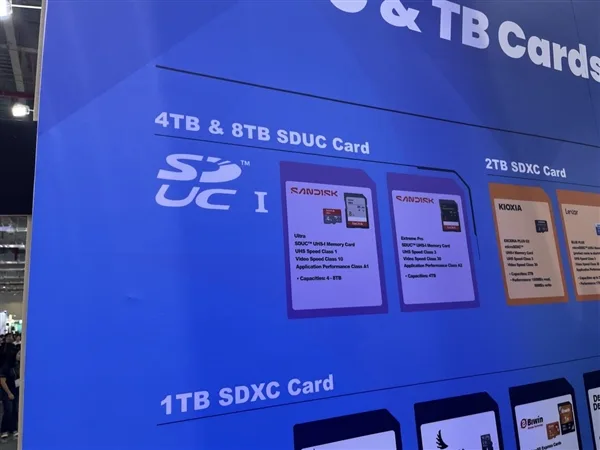
Kuai Technology reported that SanDisk first showed an 8TB SD card in 2024 and that multiple vendors at Computex 2026 now expect 8TB cards to arrive soon. The report says SanDisk is expected to use the Ultra line for a 4TB microSDUC card and 8TB SDUC card.
The speed class is just as important as capacity. The report points to UHS-I behavior, with a theoretical maximum read speed around 104MB/s and V10 and A1 ratings for the Ultra line. That means the card may be huge but not especially fast. For high-bitrate video, large game libraries, and burst-heavy cameras, sustained write speed matters more than the number printed on the package.
This is similar to what portable gaming devices face with software support, a theme that also shows up in SteamOS expanding toward Intel handhelds. Hardware can move first, but users do not benefit until standards, firmware, and accessories catch up around it.
There is a professional workflow angle too. A wedding shooter, documentary crew, or drone operator may love the idea of fewer card swaps, but they also worry about putting too much work on one piece of media. A single 8TB card concentrates risk. Until redundancy, offload speed, and device support improve, many professionals may prefer several smaller fast cards over one enormous slow card that could hold an entire job.
For hobbyists, the first compatible card reader may be just as important as the first compatible card.
Pricing could also limit the early audience. The Chinese report compares existing 2TB card prices and speculates that 4TB microSDUC could approach USD 1200 while 8TB SDUC could approach USD 2200 if current scaling holds. Even if the final numbers differ, first-generation cards will likely be specialist products.
Still, the arrival matters. Big removable storage keeps cameras, field recorders, drones, laptops, and handhelds flexible in a cloud-heavy era. The real question is not whether 8TB SD cards are impressive. They are. The question is how quickly device makers add SDUC support so the capacity becomes useful outside a spec sheet.