The reported AI college counseling trap is a useful warning because it involves a decision families treat as life-shaping. College application advice is not casual content. It affects majors, cities, tuition, career paths, and family finances. If a paid consultant quietly reads chatbot answers while presenting them as expert guidance, the problem is not only poor service. It is a breakdown of accountability.
AI can help in education planning. It can organize options, explain admission terms, compare programs, and help students ask better questions. But it should not be used as a hidden substitute for professional judgment, especially when families are paying hundreds, thousands, or even more for personalized guidance. Disclosure matters because users need to know whether advice comes from an accountable human or a probabilistic system.
We have seen similar trust gaps in other AI contexts. Our coverage of AI hallucinated reports showed how a confident answer can become dangerous when it enters a serious workflow without review. Education counseling has the same risk: a polished answer can be wrong, outdated, or too generic for a student's actual constraints.
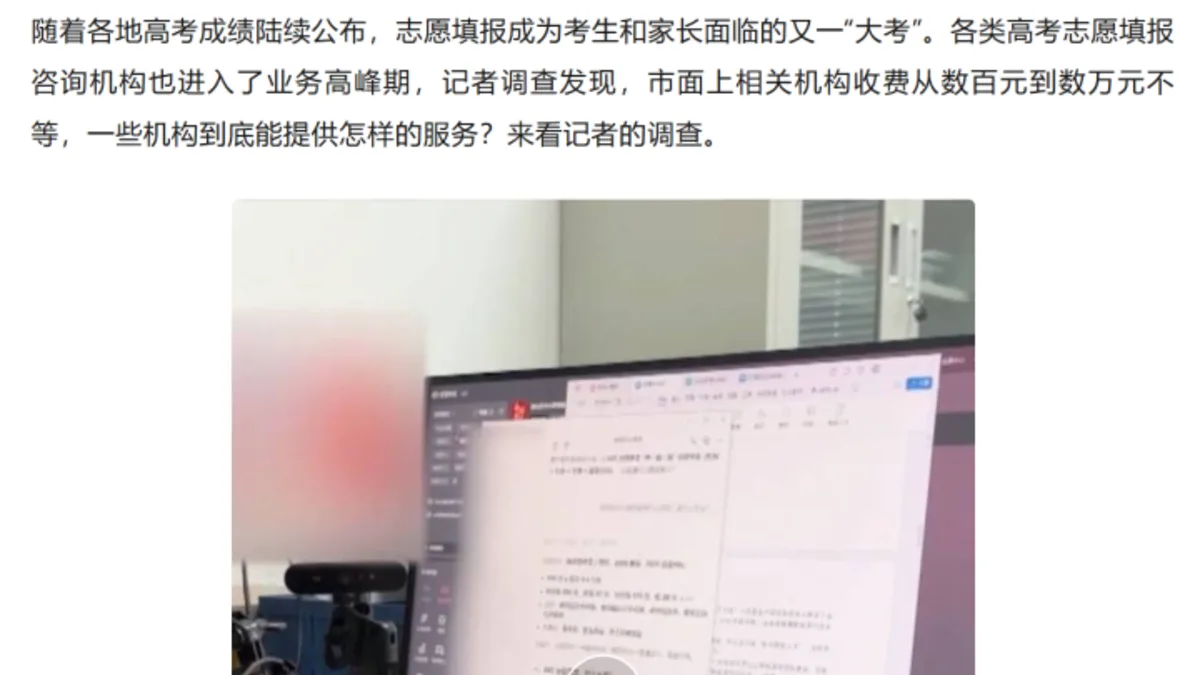
PChome reported that CCTV exposed problems in paid college application counseling, including cases where supposed professional advice was being answered with help from Qwen AI. The report says some services charge from hundreds to much higher amounts while using AI-generated responses during consultations.
The most damaging part is not that AI was involved. It is that the human service may have been sold as something more personal and expert than it really was. A counselor can use AI responsibly as a research aid, but they must check facts, understand local admission rules, and explain uncertainty. Passing the chatbot output through a human voice does not make it expert advice.
This should push education platforms toward clearer standards. If AI is used, say so. If advice is automated, label it. If a human expert reviews and takes responsibility for the recommendation, make that process visible. Families should also ask direct questions: who prepared the plan, what data was used, how recent the admission information is, and whether the service has conflicts of interest with specific schools.
The larger lesson applies across consumer AI. People are willing to use AI when the stakes are low or the role is clear. They become angry when AI is hidden behind a paid human promise. College counseling is only one example. Any business using chatbots in sensitive advice needs a simple rule: automation can support judgment, but it should not impersonate it.
Regulators and schools may also need to publish simple consumer guidance before every application season. Families should be able to identify whether a service is providing data access, essay editing, psychological support, or true admissions strategy. Those are different products. AI can assist each one differently, but the buyer should know what they are purchasing. A transparent low-cost AI planning tool is not the enemy. A high-priced human-branded service secretly leaning on generic AI answers is the problem.
The best AI use in this field should leave a record: source data, assumptions, and human review. That record gives families something to question, and it gives honest counselors a way to prove the work was not just copied from a chatbot window.