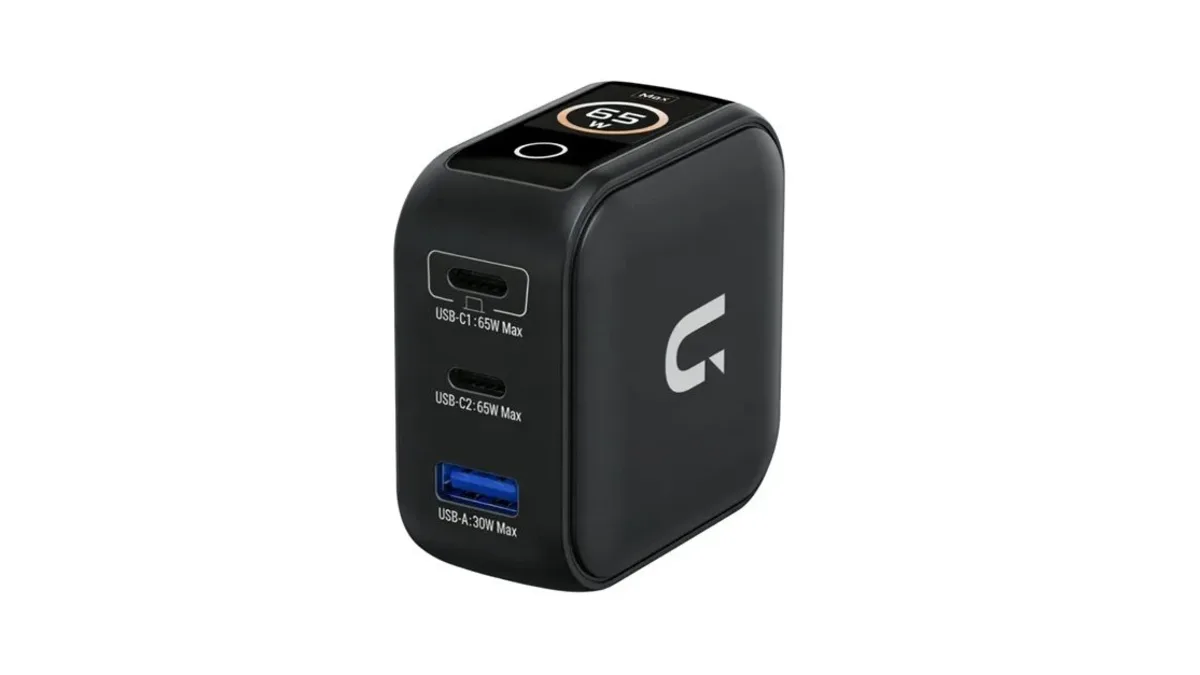
Asus a-bean 100W GaN charger is not a flashy flagship gadget, but it is the kind of accessory that changes how clean a travel bag feels. The pitch is simple: one small brick that can handle a laptop, phone, tablet, earbuds, handheld console, or power bank without forcing users to carry several chargers. In 2026, that may be more useful than another minor phone accessory.
The charger has launched in China at 179 yuan, which is roughly $25. That price is the attention grabber because 100W multi-port GaN chargers often cost much more, especially from brands with global retail presence. Asus is using a 3C+1A layout, meaning three USB-C ports and one USB-A port. Two of the USB-C ports can individually deliver up to 100W when used alone, while the third USB-C port supports up to 20W.
The physical design also looks built for travel. Asus lists dimensions of 75 x 61 x 29mm and a weight around 211g. Foldable wall prongs make it easier to slide into a bag, and the color options avoid the plain white cube look. The available combinations include Cloud White with Graphite Gray, Cool Black with Fluorescent Green, and Cool Black with Space Gray.
Gizmochina reports that Asus is using gallium nitride technology to keep the charger compact while still supporting high output. That puts it in the same practical accessory lane as our Ukko touch-screen charger coverage, though Asus is aiming for compact high-wattage value rather than a charger that explains its output through a display.
Why 100W Still Matters
A 100W charger is not only about charging a phone faster. Many thin laptops, USB-C monitors, tablets, handheld gaming PCs, and creator accessories can pull far more power than a phone. A 65W charger may be enough for a MacBook Air class device, but 100W gives users more headroom when they connect a higher-performance laptop or charge multiple devices through one brick. That extra margin is what makes a travel charger feel reliable instead of merely compact.
The USB-A port is also worth keeping. It is easy to act as if every accessory has moved to USB-C, but older cables, small gadgets, desk fans, battery cases, and travel accessories still rely on USB-A. Removing the port would look cleaner on a spec sheet but less useful in a real drawer. Asus has made a practical decision by keeping one legacy port while putting the main power where it belongs: on USB-C.
The unknown is international availability. A China launch at about $25 does not guarantee the same price in the United States, Europe, India, or the Middle East. Taxes, certification, plugs, retail margins, and warranty coverage can change the final number quickly. Buyers outside China should treat the converted price as a signal of positioning, not a promise.
Even with that caution, the a-bean charger is interesting because accessories are becoming part of the device experience. People no longer charge only a phone at night. They charge a mixed kit of work, travel, gaming, and audio hardware. A small 100W charger with four ports can remove clutter from that routine.
Asus does not need the a-bean charger to be glamorous. It needs the charger to be dependable, cool under load, safe with multi-device power sharing, and small enough to stay in a bag. If it delivers on those basics near the launch price, it could become one of the more sensible hardware buys in the current accessory wave.