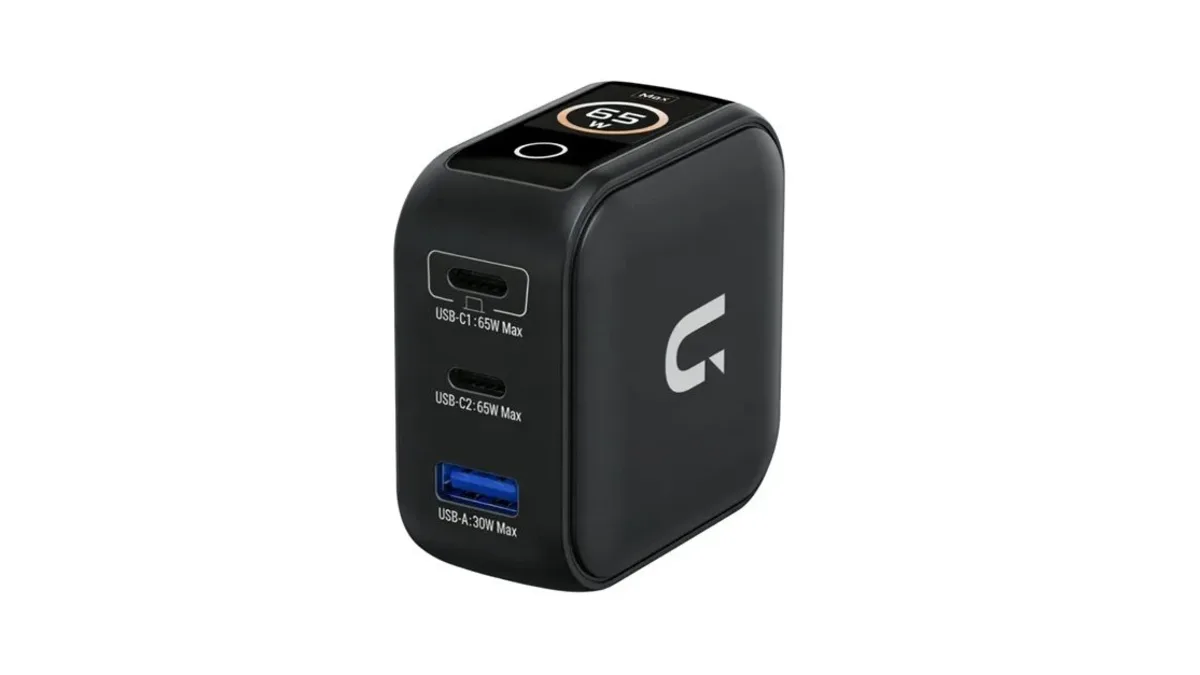
Fast chargers used to be judged by wattage, port count, size, and price. Ukko's touch-screen 65W PD charger adds another angle: visibility. A charger that can show power, time, and mode information is not necessary for everyone, but it answers a real curiosity many users have. People want to know whether their phone, tablet, laptop, or earbuds are actually charging at the speed promised.
The interesting part is the touch control. Many chargers now include tiny displays, but most are passive readouts. A touch interface lets the accessory feel more like a small tool than a wall brick. If implemented well, it can help users switch modes, understand output behavior, and troubleshoot charging without buying a separate USB power meter.
Cool3C reported that Ukko's P5265 charger supports up to 65W output, uses one USB-A and two USB-C ports, and includes a touch screen that can show charging power, time, and usage modes. The report notes a limited-time price of 799 Taiwan dollars, which makes the feature set more accessible than specialist charging tools.
The accessory market is crowded, so differentiation matters. A 65W charger alone is no longer unusual. Many brands can build compact GaN chargers with multiple ports. The display gives Ukko a clearer story, especially for users who regularly charge a laptop, phone, tablet, and portable console from the same brick.
That accessory intelligence pairs well with our coverage of Nothing Headphone 1 battery and audio details, where small hardware choices shape daily convenience. Accessories are not glamorous, but they determine how smoothly the rest of a gadget setup works. A better charger can make several devices feel easier to live with.
The main risk is durability. A charger is often tossed into bags, plugged into tight outlets, and used in hotel rooms or airports. A touch screen has to survive scratches, heat, and casual abuse. It also must remain readable without turning the charger into a fragile gadget. Ukko needs the display to feel helpful, not delicate.
Accuracy matters too. If the wattage readout is slow, vague, or inconsistent, users will stop trusting it. The best version would show enough information for normal people without becoming a diagnostic dashboard. Simple labels, clear mode changes, and reliable readings are more valuable than a busy interface.
The Ukko charger shows where charging accessories are going. Power is still the foundation, but visibility is becoming part of the product. As phones, laptops, handheld consoles, and earbuds all compete for USB-C ports, a charger that explains what it is doing can feel smarter than one that only promises a bigger number.
The broader point is that accessories are becoming more communicative. Batteries show charge curves, cables advertise power ratings, and chargers now display output in real time. That can reduce confusion in a USB-C world where the same connector can mean many different speeds. Ukko is not solving the entire standards problem, but it is giving users a clearer window into what is happening.
That clarity can also help families sharing chargers. When several people plug in phones, tablets, and laptops, nobody wants to guess which port is slowing down. A small screen will not make charging exciting, but it can make power sharing less mysterious.