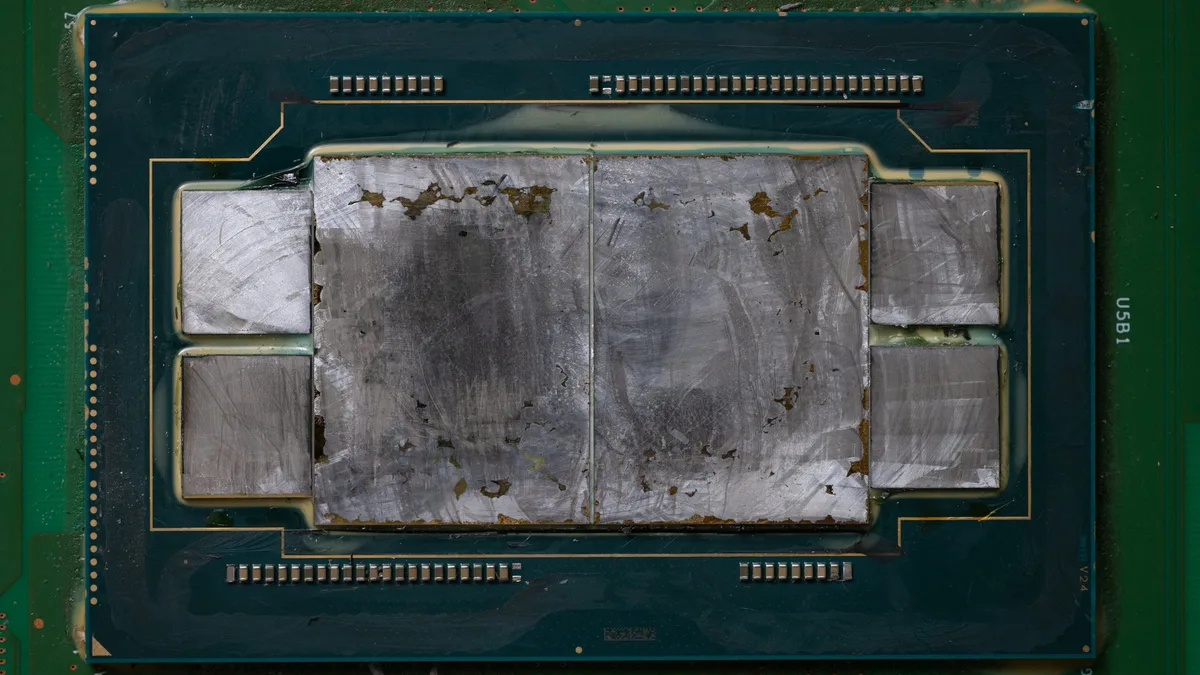
A cancelled Intel GPU sample has resurfaced in Chinese-language tech coverage, and it is more than a curiosity for collectors. The Arctic Sound Xe-HP board represents a path Intel once explored before the AI accelerator market became as urgent as it is today. Seeing the hardware now makes the abandoned roadmap feel strangely current, because multi-tile GPUs and high-bandwidth memory are exactly the themes dominating modern compute discussions.
The reported sample uses a two-tile design and four HBM2E stacks, with markings that identify it as Intel confidential engineering hardware. That is the kind of board normally seen inside labs, not in public photos. Its appearance gives enthusiasts a rare look at how Intel was thinking about scalable GPU compute before later strategy shifts moved attention toward other products and eventually newer AI platform plans.
The timing makes the leak more meaningful. Intel has been trying to rebuild confidence in graphics, accelerators, foundry plans, and data-center roadmaps while Nvidia and AMD hold stronger positions in AI hardware. A leaked cancelled board cannot change that competitive reality, but it shows that Intel was not unaware of the direction. The company had ambitious hardware concepts; the harder problem was execution, ecosystem, timing, and product continuity.
cnBeta covered the Arctic Sound sample in Chinese, noting the dual-chip design, HBM2E memory arrangement, and the broader context of Intel's cancelled graphics roadmap. The report also connects the board to Intel's older Xe-HP plans, where workstation and data-center variants were expected to scale through one, two, or four tiles.
For today's hardware market, the leak works almost like an artifact from an alternate future. If Intel had shipped more of that roadmap on time, the company might have entered the AI acceleration boom with a different base of software support and customer trust. Instead, the market consolidated around Nvidia's CUDA ecosystem while AMD built its own data-center GPU push. Intel now has to compete from a more difficult position.
The board also illustrates why hardware alone is not enough. A multi-tile GPU with HBM can be impressive, but developers need tools, drivers, libraries, documentation, and confidence that the platform will remain supported. Data-center buyers do not want a one-off engineering marvel. They want a stable roadmap that lets them plan racks, software stacks, and procurement cycles years ahead.
That is the part of the story that still feels current. AI customers are buying platforms, not isolated chips, and every cancelled accelerator teaches the same lesson: a promising board must arrive with software momentum before developers have already standardized somewhere else.
There is still value in seeing the sample. It helps explain Intel's technical ambition during a period that is often remembered mostly for delays and cancellations. It also reminds the industry that abandoned projects can contain ideas that later become mainstream. Multi-chip packaging, HBM, and specialized compute were not fringe concepts. They were difficult concepts that required the right timing.
The Arctic Sound leak does not rewrite Intel's current AI position, but it does sharpen the lesson. In hardware, being early with an idea is not the same as winning with a product. The companies that dominate are the ones that can turn engineering samples into reliable platforms before the market window closes.