Doubao's new Task Mode shows how quickly consumer AI products are moving beyond the chatbot frame. A simple chat interface is useful when users want an explanation, a rewrite, or a quick summary. It becomes limiting when the user already knows the desired outcome and wants the software to handle the steps. ByteDance appears to be pushing Doubao toward that second category: an assistant that can plan a workflow, call tools, generate files, and return something closer to a finished deliverable.
The feature matters because it changes the relationship between user and model. In a normal chat session, the burden often remains on the user to break a goal into prompts, check intermediate outputs, ask for corrections, and stitch the result together. Task Mode is meant to reduce that labor. The examples being highlighted include creating webpages without code, producing slide decks, analyzing spreadsheets, generating charts, and setting timed background tasks. That is not just a feature list; it is a claim that the AI can manage a work unit.
This is where the competition in AI assistants is becoming practical. The winning product may not be the one that sounds smartest in a single answer. It may be the one that handles the boring chain of steps with fewer mistakes. We have seen similar pressure in enterprise tools, including the shift toward agentic operations covered in network and cloud management AI. Doubao is applying that same direction to a broader productivity audience.
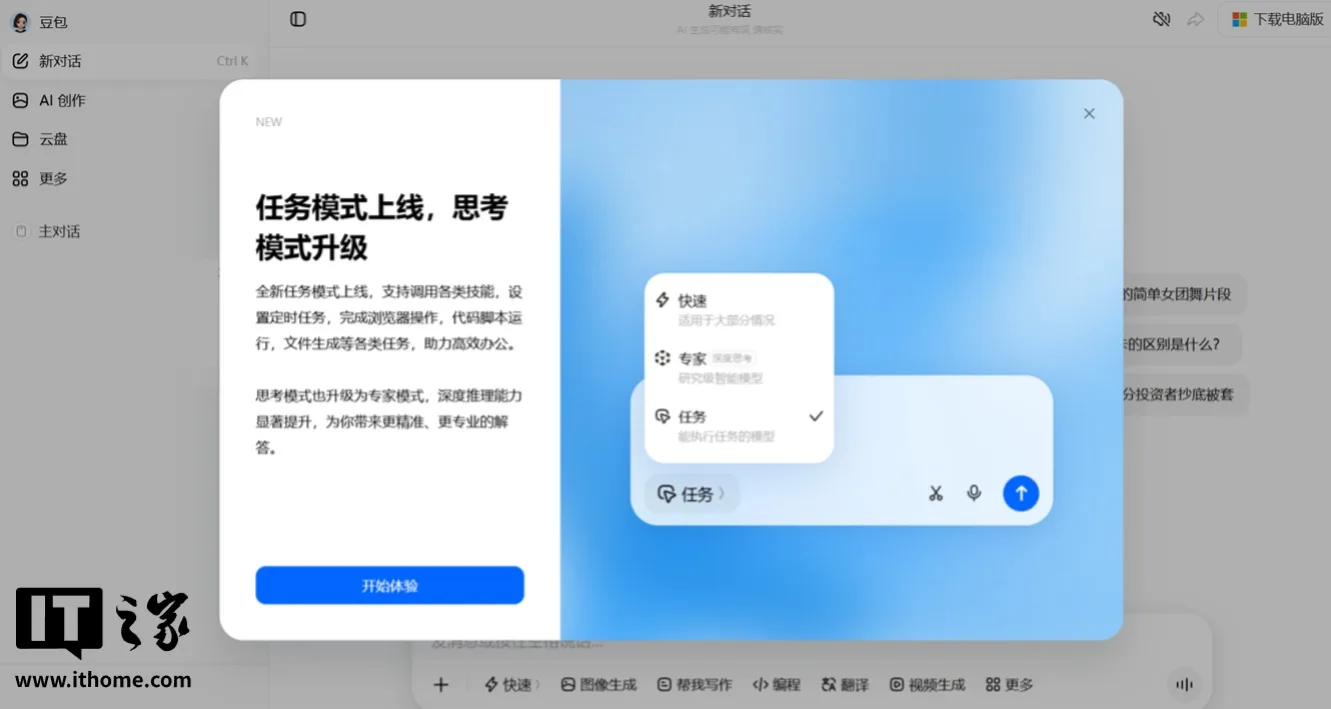
IT Home reports that Doubao now shows three modes at the top of the app interface: Fast, Expert, and Task. The report says Task Mode can perform online research, generate content, create PPT files, make charts from uploaded Excel files, and run scheduled work, while the renamed Expert Mode uses ByteDance's Doubao 2.0 Pro model for deeper reasoning.
The product strategy is also clear from the pricing split. Everyday interactions remain free, while higher-compute professional tasks become the subscription hook. That is a logical move. Users rarely want to pay just to ask a question, but they may pay when an AI produces a presentation, financial analysis, report, or small software artifact that saves measurable time. The challenge is reliability. If a generated deck looks polished but contains weak structure, or if spreadsheet analysis hides bad assumptions, the time saved can quickly turn into review work.
Task Mode is therefore a promise and a liability. It promises less prompting and more output. It also raises the standard for verification because users will treat the result as work product rather than casual text. ByteDance has the distribution to test this at scale, and Doubao's move will likely push competitors to make their own agent modes more visible. The AI assistant race is becoming less about conversation quality and more about whether the tool can finish a job without making the user become a project manager for the model.
The rollout also raises a useful design question: how much autonomy should a mainstream assistant expose by default? A task that creates a personal webpage is low risk. A task that analyzes business data, generates code, or prepares a financial presentation needs clearer checkpoints. The best version of Task Mode will probably combine automation with visible progress, editable assumptions, and easy rollback. Users want less manual work, but they still need to understand what the agent actually did.