Humanoid robot news often focuses on hardware: walking speed, hand dexterity, battery packs, and how human the machine looks. A new Chinese report about a humanoid robot "brain" is more interesting because it shifts attention to movement intelligence. If robots are going to leave demos and become useful products, they need better control models, not just stronger motors.
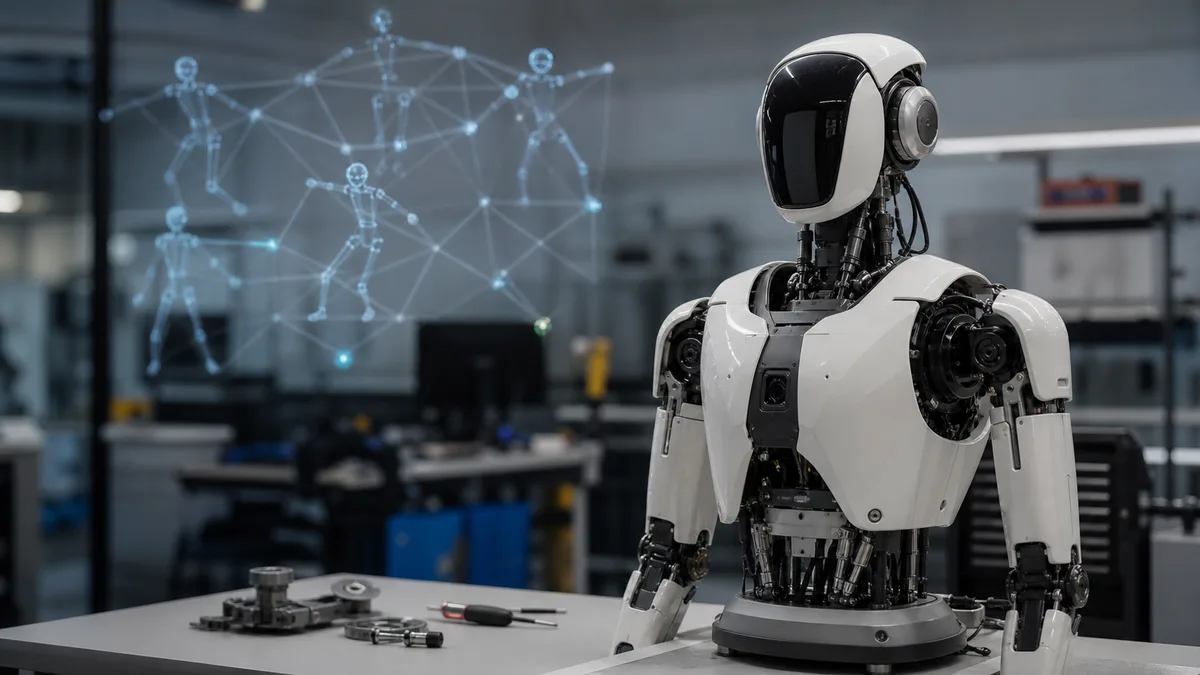
The reported model is described as a whole-body control foundation model trained on large amounts of human motion data. That matters because movement is one of the hardest parts of robotics. A robot does not only need to know what a task is. It has to balance, coordinate limbs, react in real time, and handle actions it has not practiced exactly before. That is where AI models could change the pace of development.
The consumer angle is still early, but it is not imaginary. Better movement models can eventually help home robots, companion robots, education robots, and service machines become less scripted. A robot that can adapt its motion more naturally is easier to trust around people. It can also support a wider range of tasks without needing engineers to hand-code every movement pattern.
NetEase Tech reported that Galbot released AstraBrain-WBC 0.5, described as a humanoid robot general movement-control foundation model trained on 20,000 hours of human motion data. The report says the model uses a GPT-style causal Transformer approach and is being opened with related research and code.
This is a different layer from the AI companion hardware we covered in our companion robot startup report. Companion devices focus on emotional interaction and product design. Humanoid control models focus on physical capability. The two paths may eventually meet when consumer robots need both presence and useful movement.
The open-source element is important if it holds up in practice. Robotics development is expensive, and shared models can help smaller teams test ideas without rebuilding the entire control stack. That could accelerate experimentation in labs, startups, and universities. It could also create new competition around who has the best robot body, sensors, training data, and deployment tools.
There are still major limits. A movement model is not a complete robot. Real-world use requires safe hardware, reliable perception, battery endurance, maintenance, cost control, and clear tasks. Humanoid robots also face public skepticism because many demos look impressive but do not translate into daily utility. The software race can help, but it cannot skip the hard product work.
Still, the report points to the direction robotics is taking. The next breakthrough may not be a shinier humanoid shell. It may be a better general model for how bodies move. If those models keep improving, consumer robots could become less like pre-programmed gadgets and more like adaptable machines. That shift would make the robot category far more serious than another round of stage demonstrations.
The consumer payoff will take time, but this is the kind of foundational work that can eventually make robots safer, less rigid, and more useful outside controlled demonstrations.
When movement improves, the rest of the robot experience can finally become less scripted.