June 2026 gadget coverage is less about one dominant product and more about practical buying behavior. People are paying attention to devices that improve something they already do every day: work on a laptop, record video, listen while traveling, fly a compact drone, carry a gaming handheld, or keep a wearable alive for longer between charges. That makes this a different kind of device cycle from the old spec-race seasons, where a brighter screen or thinner frame could carry the story by itself.
The market is still busy, but buyers are asking sharper questions. Does the product have a real model number, a clear launch market, a believable price, and a reason to exist beside last year's hardware? A device that cannot answer those questions looks weak, even if the marketing page is polished. That is why detailed product pages matter more now. The useful information is not hidden in broad slogans; it is in configuration options, replacement parts, battery claims, warranty notes, and regional availability.
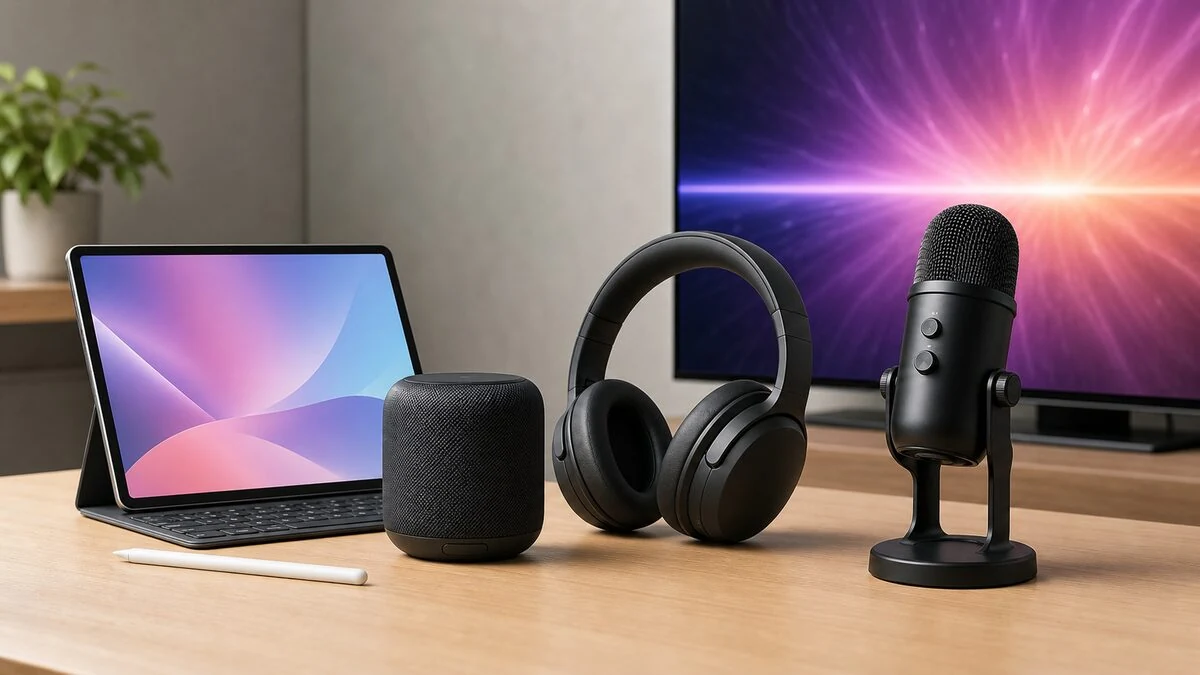
TechRadar highlighted a broad mix of June-tested devices, and the interesting signal is not that every item belongs to the same category. It is that each category is being judged by a job. A creator camera is judged by stabilization and workflow. A speaker is judged by durability and sound for its size. A headset is judged by latency, comfort, and microphone quality. A display is judged by gaming features and real living-room use, not only panel buzzwords.
That is the same reason our individual gadget coverage has moved toward specific model detail instead of broad launch summaries. A buyer comparing the DJI Osmo Pocket 3 does not need vague creator language; they need to know why the one-inch sensor, three-axis gimbal, vertical shooting support, and Creator Combo change the value. Someone considering the Potensic ATOM 3 needs flight time, kit differences, camera behavior, and market availability before the price means anything.
Portable computing shows the same pattern. The MacBook Air M5 and Razer Blade 14 are both laptops, but they are not really chasing the same buyer. One is about mainstream battery life, size choice, and quiet daily performance. The other is about GPU options, high-refresh gaming, and the compromises that come with more graphics power in a portable shell. Treating them as one broad laptop story would be useless.
Wearables and audio are also becoming more grounded. The Xiaomi Smart Band 10 Pro only makes sense if the buyer understands its China-market pricing, battery promise, health features, and display class. The Sony WH-1000XM6 is not just another premium headphone; its value depends on noise cancellation, call quality, color-specific model suffixes, travel comfort, and whether the local price is justified against older Sony models still on sale.
The better way to read June's device market is therefore simple: practical products are winning attention when their details are clear. Buyers want fewer vague category roundups and more exact product answers. They want to know what model launched, where it is sold, what it costs, what variants exist, what changed from the last version, and what trade-offs are still present. Any gadget article that skips those points is not doing enough work.
That is the standard this site should hold for gadget coverage. A useful product article should stand on its own, name the exact device, link to the official or direct source when possible, explain price and market context, and avoid padded tables or decorative diagrams that do not help a buyer. The gadget market is crowded enough already. The coverage should make decisions clearer, not add another layer of empty noise.