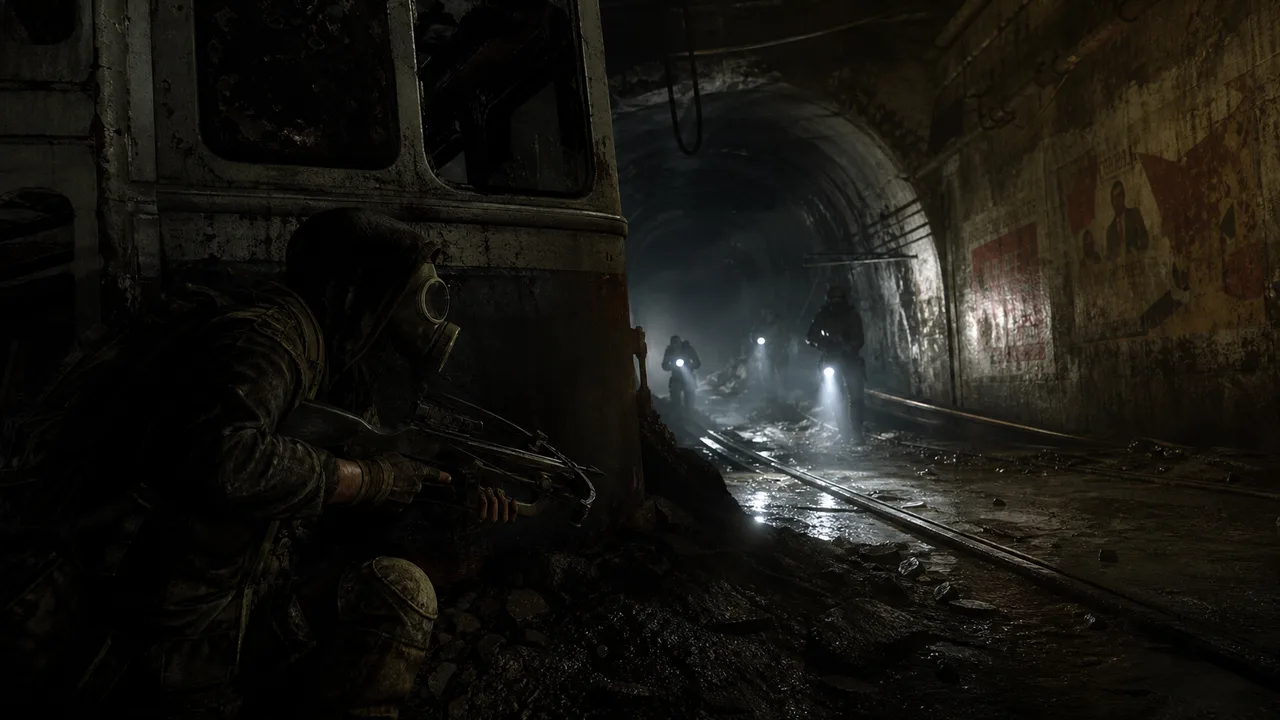
Metro 2039 looks like a return to the series most oppressive strengths. The new trailer puts the focus back on tunnel stealth, scarce movement, bad information, and a Moscow underground where survival is political before it is heroic. After Metro Exodus opened the world and gave players broader spaces, 2039 appears to be tightening the frame again. That matters because Metro has always been at its best when every bullet, filter, whisper, and flickering lamp feels like part of the same pressure system.
The premise gives the sequel a strong dramatic hook. Hunter, once a legendary figure in the Spartan Order, is now presented as a tyrannical leader who has used lies and propaganda to control the Metro. The player takes the role of The Stranger, a figure moving against that corrupted myth. It is a natural evolution for the series. Metro stories have never been only about monsters in the dark; they are also about how frightened communities invent dangerous politics underground.
The trailer reportedly shows new tools including a stealth weapon called The Shatun and breaching charges, which suggests 4A Games is expanding tactical options without turning the game into a power fantasy. That distinction is important. Metro should let the player plan and improvise, but it loses texture if the protagonist feels like an invincible operator. The series works because the environment keeps pushing back, from air quality to ammo economy to enemies that make noise discipline matter.
TechRadar reports a February 2027 release window for PC, PlayStation 5, and Xbox Series X and S, with the new trailer shown during the Xbox Games Showcase. The report also highlights the in-engine footage, the return to stealth-action pacing, and the story emphasis on Hunter's transformation into a figure of control.
That platform spread puts Metro 2039 in a demanding technical position. 4A Games has a reputation for pushing lighting, atmosphere, and rendering features hard, and modern Metro trailers tend to invite hardware expectations before players have seen real settings menus. The smartest path would be to build a game that scales cleanly across console modes and a wide PC range. As handheld PCs become more serious, something we recently covered through the Intel Arc G3 handheld demo, even visually ambitious shooters need thoughtful lower-power profiles.
The tunnels also give 2039 a design advantage. Dense spaces can be more memorable than larger maps when the layout is legible and dangerous. Metro can use sound, patrol routes, cramped geometry, and environmental storytelling to make a small area feel more intense than an open field. A locked door, a coughing guard, a failing light, or a mutant echo can become meaningful when the player is not sprinting through a checklist.
If Metro 2039 keeps that restraint, it could feel like a necessary correction rather than a retreat. Exodus proved that the franchise could survive outside the Metro, but 2039 can remind players why the underground was frightening in the first place. The most promising sign is not just the trailer's action. It is the word liar. Metro horror is strongest when the monsters are not the only things hunting the player.