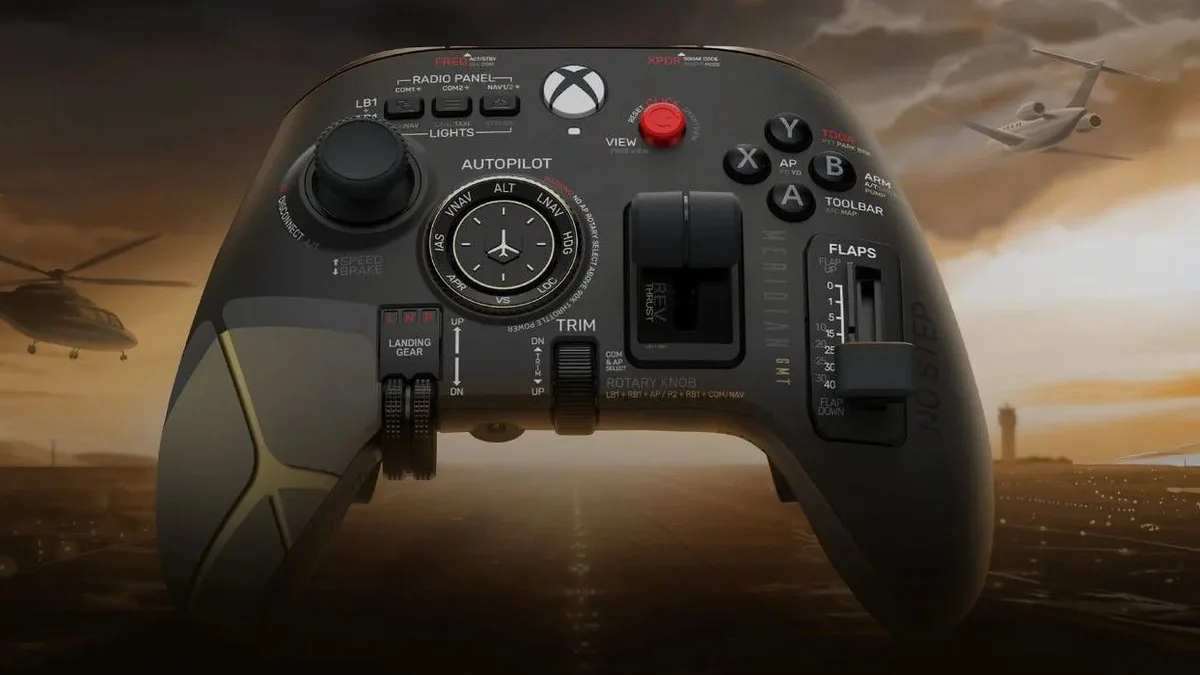
PowerA's new Microsoft Flight Simulator controller is a smart reminder that not every gaming accessory needs to be another general-purpose pad. Flight sims are playable with a normal controller, but the experience often feels like a compromise. Important cockpit actions end up buried in menus, button combinations, or awkward mappings. PowerA and Meridian GMT are trying to put more of that control surface directly into the player's hands.
The design keeps a familiar Xbox-style controller shape, which is the clever part. A full yoke, throttle quadrant, or flight stick can be more immersive, but those setups need desk space and a more dedicated player. A handheld flight controller is easier to pick up, easier to store, and easier for console players who sit on a couch. It bridges the gap between a standard controller and a full simulator rig.
The visible control set is built around Microsoft Flight Simulator 2024 needs. It includes a throttle lever, flap controls, landing gear, a rotary trim knob, lights and radio buttons, and dedicated autopilot controls where a D-pad would normally sit. That means the accessory is not just themed plastic. It moves common flight tasks onto physical inputs, which can make takeoff, approach, and cruising less fiddly.
Windows Central reports that the controller is being made in collaboration with Meridian GMT and will work with Xbox and PC. Readers who follow gaming hardware can also compare it with our PlayStation Link USB adapter coverage, where platform-specific accessories solve a very different part of the gaming setup.
Why A Handheld Flight Controller Makes Sense
Flight Simulator has a broad audience. Some players own expensive cockpit gear and treat the sim like a hobby platform. Others fly casually to explore cities, landmarks, and weather. A controller like this targets the middle group: people who want better controls but do not want to rebuild their desk around the game. That middle group is often underserved.
The controller could also help Xbox players feel less like second-class sim users. PC players can choose from a wide range of peripherals, while console players are limited by compatibility, space, and living-room convenience. A controller with an Xbox button, console support, and flight-specific inputs gives Xbox sim pilots a cleaner upgrade path.
The unknowns are price, release timing, build quality, and how the back of the controller is arranged. Flight controls need precision. A throttle lever that feels loose, trim controls that step too aggressively, or buttons that are hard to distinguish by touch could weaken the whole idea. PowerA has to make the hardware feel like a tool, not only a novelty shell.
Software mapping will matter just as much. The accessory should be useful out of the box with Microsoft Flight Simulator 2024, but it should also allow enough customization for different aircraft and player preferences. Sim players often care deeply about control layouts, and a fixed mapping would limit the hardware's appeal.
If PowerA gets the basics right, this could become a category rather than a one-off. Racing games have wheels, fighting games have sticks, and flight sims deserve more couch-friendly hardware. A handheld cockpit controller will not replace serious yokes and throttles, but it could make the sim more approachable for players who want more realism without more furniture.