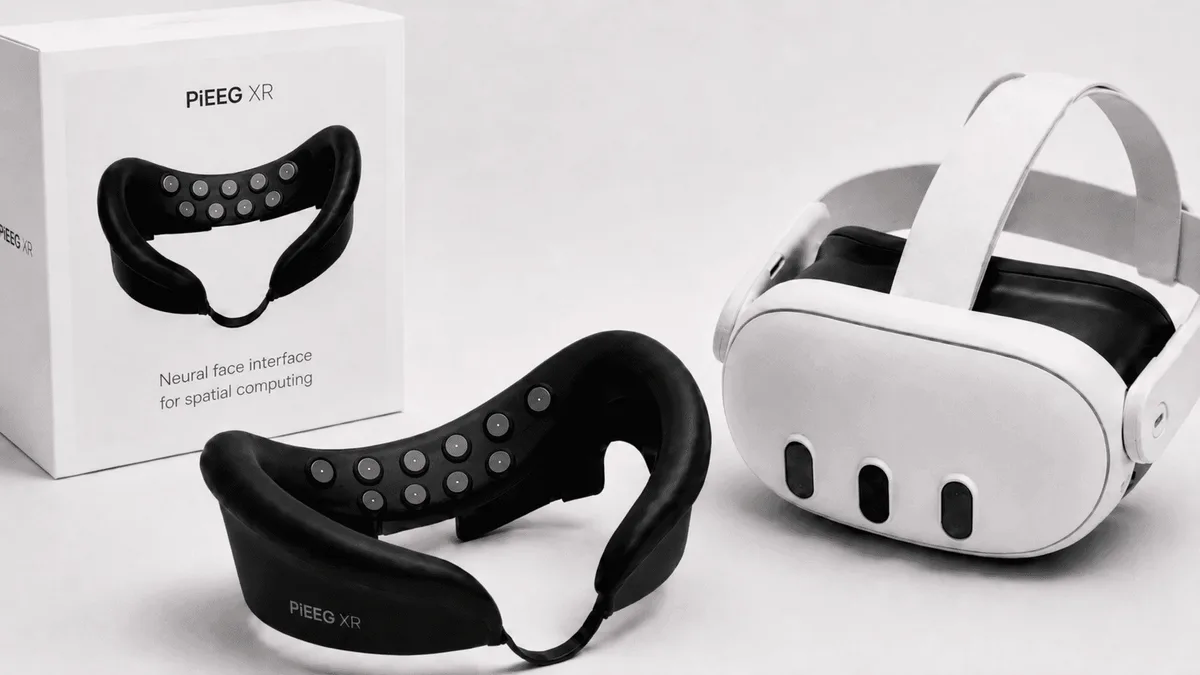
PiEEG XR is one of the more unusual Quest 3 accessories to appear this year because it does not try to add another camera to the headset. Instead, it replaces the standard facial interface with a sensor-equipped frame that reads biosignals from around the face and forehead. The goal is to help VR avatars show expressions without relying on conventional face tracking hardware.
That distinction matters. Camera-based face tracking looks for visible movement. PiEEG XR is trying to read signals from the user's body and then map those signals into software. In demos, developer Ildar Rakhmatulin trains the system to recognize a smile and then connect that recognition to a VR avatar expression. It is a more experimental approach than a plug-and-play consumer face tracker.
The product is aimed at developers, researchers, educators, and VRChat experimenters rather than everyday Quest buyers who want instant results. That framing is important because biosignal input requires calibration, interpretation, comfort testing, and software support. A sensor frame can become powerful only when developers build reliable mappings from raw signals to useful actions.
UploadVR reports that PiEEG XR captures biosignals and streams the data into software for avatar reactions, mixed-reality effects, and experimental controls. The idea pairs naturally with our coverage of wearable hardware entering sensitive real-world spaces, because sensors on the face are useful only if users trust how data is handled.
More Than A Smile Detector
The most interesting possibility is control beyond facial expression. If a device can detect repeatable facial signals, focus states, or muscle patterns, developers could map them to avatar gestures, menu actions, or mixed-reality effects. The report mentions ideas such as OSC or WebSocket integrations, which would make the accessory more open to community-built experiments than a locked-down consumer add-on.
That does not mean PiEEG XR should be confused with mind reading. The useful version is much narrower and more practical: train a signal, associate it with an action, and repeat it reliably. That is still difficult. Face fit, sweat, movement, glasses, lighting-independent calibration, skin contact, and headset comfort can all affect the result. A neural face interface has to be comfortable before it can become clever.
There is also a product gap left by existing headsets. Meta Quest Pro included eye and face tracking, but Quest 3 and Quest 3S do not. Some users want more expressive avatars without buying a different headset. A hardware accessory could fill part of that gap if it becomes reliable, affordable, and easy enough for creators to support.
The developer-kit nature is both the weakness and the opportunity. Mainstream buyers may not want to train mappings or connect data streams to apps. Developers, however, often need exactly that level of access. If PiEEG XR becomes a hackable kit, it could help define what expressive input looks like outside high-end headsets.
VR hardware still needs better ways to carry human expression into virtual spaces. Hand tracking and controllers cover movement, but the face remains a hard problem. PiEEG XR is not a finished answer. It is a promising experiment that points toward a future where avatar expression may come from biological signals, not only cameras.