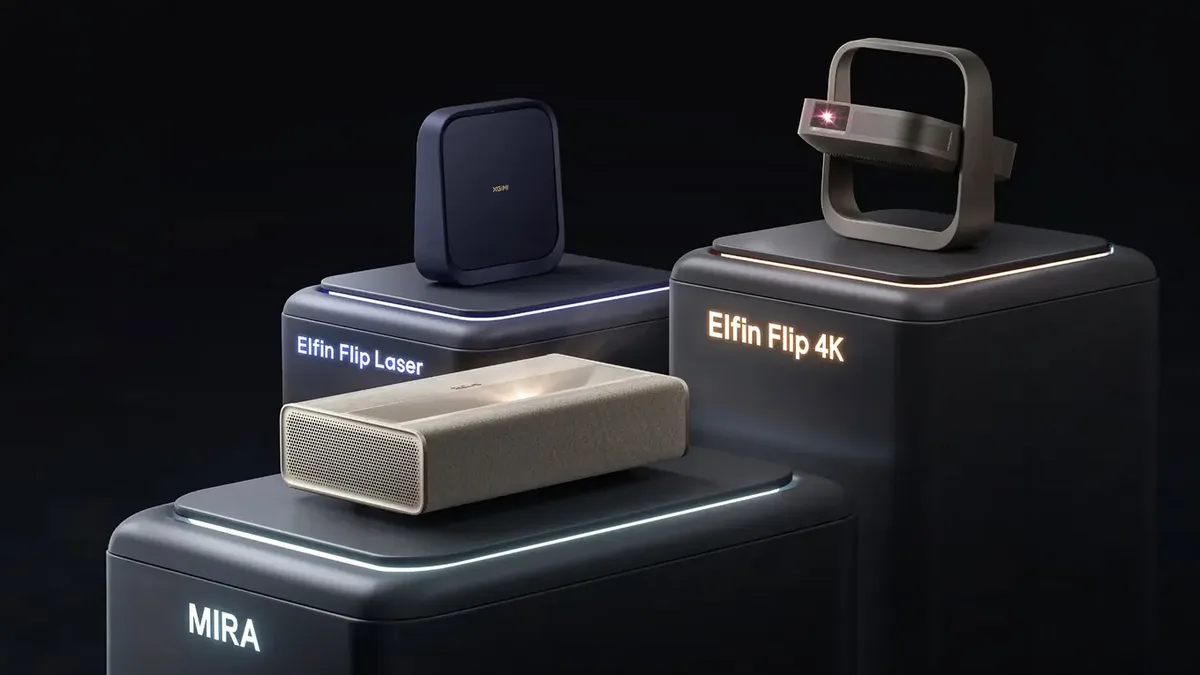
XGIMI is treating projectors like a full product family, not a single living-room box. Its latest launch tease covers three different models: Elfin Flip 4K, Elfin Flip Laser, and MIRA. That matters because projector buyers are not all solving the same problem. Some want a portable bedroom screen. Some want a brighter living-room display. Others want an ultra-short-throw setup that can sit near the wall like a TV alternative.
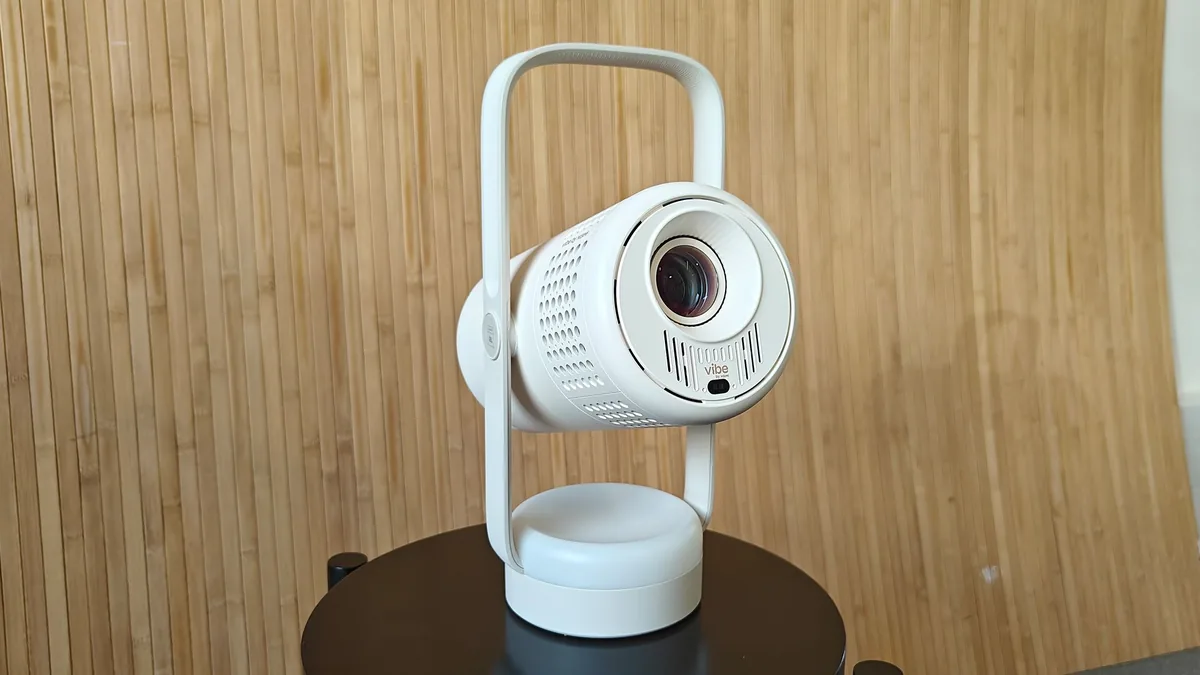
The Elfin Flip models are the most flexible of the group. Both use a flip-out stand that doubles as the tilt axis, making it easier to aim the image at a wall or ceiling. That small mechanical decision is more useful than it sounds. A projector often lives in temporary spaces, and a built-in stand reduces the need for improvised books, tripods, or awkward shelves. It also makes ceiling viewing more realistic for bedrooms and dorm rooms.
The two Elfin versions take different routes. Elfin Flip 4K is the resolution-first model, supporting 4K at 60Hz and 1080p at 120Hz, with variable refresh rate for gaming. Elfin Flip Laser uses a triple-laser light source and is positioned around image sharpness, but it is limited to 1080p at 60Hz. Both models are expected to lack built-in batteries, so they are portable in shape rather than truly cordless.
Android Authority reports that preorders are planned for this month, with sales following next month. The report also notes Japanese pricing around 206,800 yen for Elfin Flip 4K and 139,800 yen for Elfin Flip Laser, though US pricing may land differently. If you are building a bigger streaming setup, our Google TV Streamer update coverage is a useful companion because software and input support matter as much as the display device.
MIRA Is The TV Alternative
MIRA is the more permanent home-cinema option. It is an ultra-short-throw projector, which means it can sit near the wall and cast a large image without needing a long throw distance across the room. Based on regional launches, it supports 4K video, claims 2,000 ISO lumens of brightness, supports HDR10+, and includes a 2.1-channel sound system tuned by Harman Kardon with 360-degree output.
The pricing signal from China is 6,499 yuan, or roughly $960 before regional adjustments. If global pricing stays near that class, MIRA could be interesting for people who want a large image without mounting a projector on the ceiling. Ultra-short-throw models are not automatically cheaper than big TVs, but they can make sense when buyers want a very large picture and a cleaner installation.
Google TV is the software angle to watch. In Japan, the Elfin models run Google TV, but global software details can vary by region. A projector with built-in streaming should still be judged by app support, update policy, remote quality, input lag, HDMI behavior, and how easily it handles audio output. A good picture is only half the living-room experience.
The launch also shows how projector makers are dividing the market more intelligently. Portable 1080p, portable 4K, laser brightness, gaming refresh, and ultra-short-throw living-room placement are different needs. By launching multiple models together, XGIMI can speak to buyers who might otherwise drift toward either a budget projector or a traditional TV.
The caution is brightness expectations. Projectors always look better in controlled light, and headline lumens do not replace room planning. But XGIMI's new lineup gives buyers more ways to choose the right compromise. The best model will depend less on which one sounds most premium and more on where the projector will actually live.