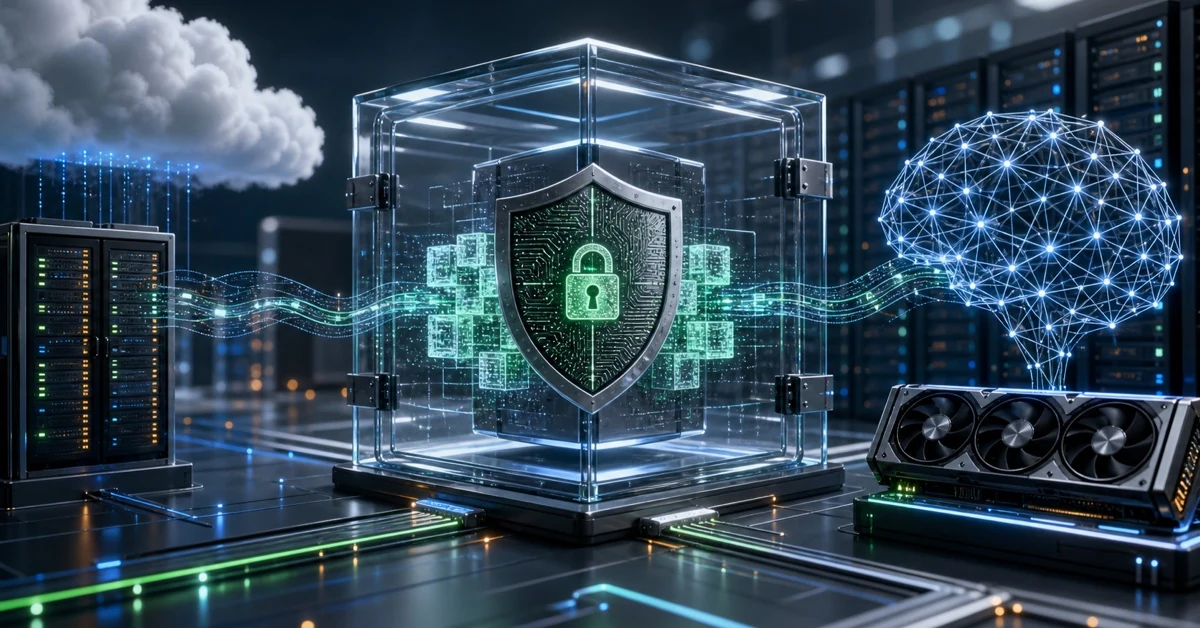
AI has made cloud security decisions more complicated. Businesses are no longer only storing files, running databases, or hosting applications. They are sending prompts, documents, customer records, code, call transcripts, images, embeddings, model outputs, and analytics data into AI systems. That raises a direct question: should sensitive AI workloads run in a private AI cloud or a public AI cloud?
There is no single answer. A private AI cloud can give a company more control over infrastructure, access, data location, and model operations. A public AI cloud can offer stronger built-in security services, faster access to modern AI hardware, mature compliance programs, and managed AI platforms. Either model can be safe. Either model can be risky if it is poorly designed.
The safer choice depends on the data, the workload, the team, the compliance requirements, and the controls around the AI system. This guide explains the difference between private AI cloud and public AI cloud, where each model is stronger, and how businesses should decide which one fits their risk profile.
What Is a Private AI Cloud?
A private AI cloud is an AI infrastructure environment dedicated to one organization. It may run in the company's own data center, in a hosted private cloud, or on dedicated infrastructure managed by a provider. The key point is isolation and control. The organization has more say over hardware, network design, data placement, identity, monitoring, model access, and operating procedures.
Private AI cloud is often used when a business handles highly sensitive data, strict regulatory obligations, confidential research, proprietary models, national security workloads, or workloads that cannot easily leave a controlled environment.
What Is a Public AI Cloud?
A public AI cloud is an AI environment built on a large cloud provider's shared platform. Customers use managed AI services, hosted models, GPU or TPU instances, vector databases, data platforms, security tools, and deployment services. The underlying infrastructure is shared across many customers, but each customer environment is logically isolated.
Public AI cloud is popular because it gives businesses fast access to AI capabilities without buying and operating all infrastructure themselves. Teams can experiment, scale, use managed models, deploy AI applications globally, and access advanced security features without building everything from scratch.
The Short Answer: Which One Is Safer?
Private AI cloud is often safer for the most sensitive data when the organization has strong security, engineering, and operations maturity. Public AI cloud is often safer for many normal business workloads when the provider's security controls are configured properly and the customer manages data governance well.
That may sound surprising, but security is not only about where a system runs. It is also about patching, identity, monitoring, encryption, incident response, backup, vulnerability management, logging, and employee behavior. A poorly run private AI cloud can be less safe than a well-configured public AI cloud. A poorly governed public AI cloud can expose data even if the provider's platform is strong.
| Question | Private AI cloud advantage | Public AI cloud advantage |
|---|---|---|
| Who controls the infrastructure? | The business has more direct control over hardware, networks, storage, and operating rules. | The provider operates a mature platform with global security investment. |
| How quickly can AI services launch? | Slower unless the company already has AI infrastructure and skills. | Faster access to managed models, GPUs, APIs, data tools, and deployment services. |
| Who handles security operations? | The company or its private cloud operator carries more responsibility. | The provider handles many infrastructure controls, while the customer configures its environment. |
| How much customization is possible? | High. Architecture, model hosting, network design, and data controls can be tailored. | Moderate to high, but within provider services, policies, and regional limits. |
| What is the main safety risk? | Weak internal operations, outdated systems, limited monitoring, or scarce AI security skills. | Misconfiguration, over-permissive access, unclear data use, or accidental exposure through services. |
How AI Changes the Data Risk
AI workloads are different from traditional applications because data may appear in more places. A single AI feature can touch raw documents, extracted text, embeddings, prompts, model context, logs, analytics records, output history, feedback data, and fine-tuning datasets. If those layers are not governed, sensitive information can spread quietly.
For example, a support chatbot may process customer messages, order history, payment notes, and internal troubleshooting documents. A coding assistant may see proprietary source code and architecture details. A healthcare AI tool may touch patient notes and medical images. A legal AI workflow may process contracts and privileged documents.
The cloud model matters, but the full AI data lifecycle matters more.
Where Private AI Cloud Is Safer
Private AI cloud is strongest when the organization needs strict control over data, infrastructure, model operations, and legal exposure. It can reduce dependency on shared provider services and limit where sensitive data travels.
Private AI cloud may be the safer choice when:
- Data cannot leave a controlled environment. This can apply to defense, government, regulated healthcare, critical infrastructure, and sensitive research.
- The business runs proprietary models. A company may want full control over model weights, training data, tuning pipelines, and inference systems.
- Custom security architecture is required. Network isolation, dedicated hardware, local key management, or specialized monitoring may be easier to enforce.
- Operational access must be tightly restricted. The company may need strict rules around who can administer infrastructure and where support teams are located.
- Regulators or contracts require dedicated control. Some industries or customers may require stronger separation than a standard public cloud service provides.
The tradeoff is responsibility. Private AI cloud requires strong patching, capacity planning, GPU operations, vulnerability management, observability, access reviews, backup, disaster recovery, and AI model governance. If the team cannot operate those areas well, the theoretical control advantage can disappear.
Where Public AI Cloud Is Safer
Public AI cloud can be safer for many businesses because major cloud providers invest heavily in infrastructure security, physical security, compliance programs, identity services, logging, encryption, threat detection, and managed AI controls. A small or mid-sized company may not be able to match that depth on its own.
Public AI cloud may be the safer choice when:
- The business needs mature managed security. Providers offer identity, encryption, monitoring, logging, and policy services that can be deployed quickly.
- The AI workload needs fast scaling. Training, inference, evaluation, and experiments can require bursts of GPU capacity.
- The team lacks private AI infrastructure skills. Renting managed services can reduce operational mistakes.
- Compliance evidence is important. Large providers often maintain certifications and audit reports customers can use in vendor reviews.
- The data can be protected through strong governance. Redaction, access controls, encryption, retention rules, and private networking can reduce risk.
The main risk is misconfiguration. Public cloud gives teams powerful options, but those options must be used correctly. Overly broad permissions, exposed storage, weak API controls, unclear data retention, and unreviewed AI logging can create serious data exposure.
Safety Comparison by Business Scenario
The right answer changes by use case. A company should not choose private or public AI cloud based only on general preference. It should classify the workload first.
| Scenario | Often safer choice | Reason | Required controls |
|---|---|---|---|
| Highly sensitive government, defense, or critical infrastructure AI | Private AI cloud or sovereign private environment | Strict access, jurisdiction, and operational control may be required. | Dedicated infrastructure, local operations, encryption keys, audit logs, and recovery plans. |
| Enterprise chatbot using internal knowledge documents | Public or private, depending on document sensitivity | Risk depends on what documents are indexed and how retrieval is controlled. | Document permissions, retrieval filtering, prompt logging rules, and output review. |
| Customer support AI using order and ticket history | Public AI cloud with strong governance is often practical | Managed services can improve speed and monitoring if data is controlled well. | PII controls, access restrictions, retention policy, redaction, and customer consent where needed. |
| Training a proprietary model on confidential company data | Private AI cloud or dedicated public cloud environment | Model weights, training data, and tuning pipelines may need tight protection. | Isolated training environment, key management, data lineage, and model artifact controls. |
| Marketing content generation with non-sensitive prompts | Public AI cloud | Low sensitivity usually does not justify private AI infrastructure. | Brand review, account security, usage policy, and output verification. |
Security Control Scorecard
Private and public AI cloud should be compared by controls, not labels. The safer environment is the one that can prove stronger protection for the specific workload.
Key Controls Every AI Cloud Needs
Whether a business chooses private AI cloud or public AI cloud, several controls are non-negotiable. Without them, the cloud model will not save the business from data exposure.
- Data classification. Know which data is public, internal, confidential, regulated, or restricted.
- Access control. Use least privilege, strong identity, multi-factor authentication, and regular access reviews.
- Encryption. Protect data at rest, in transit, and where possible during processing through confidential computing or secure enclaves.
- Prompt and output policy. Define what employees can submit to AI systems and how outputs should be reviewed.
- Logging and retention rules. Decide which prompts, outputs, embeddings, and model interactions are stored and for how long.
- Private networking. Avoid exposing AI endpoints, databases, storage, and vector stores to the open internet.
- Model governance. Track models, versions, training data, evaluation results, and approval status.
- Incident response. Prepare for data leakage, prompt injection, model misuse, account compromise, and service outage.
Private AI Cloud Risks
Private AI cloud can feel safer because it is dedicated. But dedicated does not automatically mean secure. Common private AI cloud risks include outdated infrastructure, weak patching, poor monitoring, limited redundancy, undertrained administrators, and lack of AI-specific security controls.
Another risk is cost pressure. AI infrastructure is expensive. If a company buys GPUs but cannot keep them fully utilized, it may cut corners on backup, observability, or security tooling to control spending. That can make a private environment less resilient than expected.
Public AI Cloud Risks
Public AI cloud risk usually comes from configuration and governance. Teams may connect sensitive data to managed AI services without clear approval. Developers may store prompts and outputs in logs. Storage may be exposed accidentally. Identity permissions may become too broad. AI tools may be adopted by employees before security teams understand how data is handled.
Public cloud also requires careful review of provider terms. Businesses should understand whether customer data is used for training, where data is stored, how logs are retained, what privacy options exist, and which controls are available for enterprise customers.
The AI Security Problem Is Larger Than Infrastructure
The private-versus-public debate can become too narrow if it only focuses on servers. AI systems create security questions across the full lifecycle: data collection, preparation, retrieval, prompting, model execution, output handling, logging, monitoring, feedback, and retraining. A company can choose a private AI cloud and still leak data through logs. It can choose a public AI cloud and still protect data well with strong governance, private networking, encryption, and strict access controls.
The safer model is the one that controls the entire AI workflow. That means asking where sensitive data appears, who can access it, how long it is retained, whether it is used for training, how outputs are reviewed, and how incidents are detected.
| AI layer | Main risk | Private AI cloud control | Public AI cloud control |
|---|---|---|---|
| Source data | Sensitive records are copied into uncontrolled datasets. | Keep raw data in a dedicated environment with strict segmentation. | Use data classification, private connectivity, access policies, and approved storage locations. |
| Prompts | Employees submit confidential information to tools without approval. | Route prompts through internal gateways and policy filters. | Use enterprise AI services with clear retention, logging, and no-training commitments. |
| Retrieval | RAG systems expose documents to users who should not see them. | Mirror existing document permissions inside the retrieval layer. | Use identity-aware retrieval, filtered indexes, and tenant isolation. |
| Model runtime | Model inputs or outputs are visible to too many operators or systems. | Run models on isolated infrastructure with limited administrator access. | Use private endpoints, encryption, confidential computing where available, and provider access controls. |
| Logs and telemetry | Prompts, outputs, or customer details are stored in logs for too long. | Centralize log redaction and retention in the private environment. | Configure log controls, masking, retention periods, and export restrictions. |
| Feedback and fine-tuning | Production data is reused for training without consent or governance. | Separate training approval from inference operations. | Use explicit training controls, dataset approval, lineage tracking, and vendor terms review. |
AI-Specific Threats to Consider
AI cloud security includes traditional cloud risks, but it also adds model-specific risks. These risks should be reviewed before choosing private or public deployment.
| Threat | What can happen | How to reduce risk |
|---|---|---|
| Prompt injection | A malicious document, website, ticket, or user message tricks the AI system into ignoring instructions or exposing data. | Use input filtering, retrieval boundaries, system prompt hardening, output validation, and least-privilege tool access. |
| Data leakage through output | The model returns private data, internal instructions, secrets, or information from another user or tenant. | Apply permission-aware retrieval, output filters, redaction, tenant isolation, and human review for sensitive workflows. |
| Training data exposure | Confidential training data becomes recoverable through model behavior or poor dataset handling. | Limit training datasets, remove secrets, track lineage, evaluate memorization risk, and control model artifact access. |
| Model theft | Proprietary weights, prompts, evaluation sets, or fine-tuned models are copied or extracted. | Protect model registries, restrict downloads, monitor access, watermark where useful, and separate duties. |
| Tool abuse | An AI agent or application calls cloud APIs, databases, email, or ticketing systems in an unsafe way. | Use scoped tool permissions, approval gates, sandboxing, transaction limits, and audit logs. |
| Shadow AI | Employees use unapproved AI tools because official options are slow or unclear. | Provide approved tools, publish usage rules, monitor risky data movement, and train teams on safe AI use. |
Common Private AI Cloud Architecture Patterns
Private AI cloud can take several forms. The right pattern depends on whether the company is training models, hosting models, running retrieval systems, or supporting internal AI applications.
- Dedicated training cluster. Used for high-value model training, fine-tuning, or research where datasets and model weights must remain tightly controlled.
- Private inference platform. Hosts approved models for internal applications, often behind private APIs, identity controls, logging, and rate limits.
- Secure RAG environment. Keeps document indexes, embeddings, source files, and retrieval logic inside a controlled environment.
- Model registry and artifact vault. Stores model versions, evaluation results, prompts, datasets, and deployment approvals.
- Air-gapped or restricted environment. Used for the highest-sensitivity workloads where internet access is limited or heavily controlled.
- Hosted private AI cloud. Dedicated infrastructure operated by a provider under strict contractual, jurisdictional, or compliance controls.
These patterns increase control, but they also increase engineering responsibility. Teams must plan for patching, GPU drivers, image security, orchestration, monitoring, key management, incident response, and disaster recovery.
Common Public AI Cloud Architecture Patterns
Public AI cloud can also be deployed in different ways. The safest public model is usually not a casual API call from a developer laptop. It is an enterprise-controlled architecture with identity, network, data, and logging controls.
- Managed model API with enterprise controls. The business uses a hosted model service with data protection terms, private access, logging rules, and account-level governance.
- Dedicated cloud account or subscription for AI. AI workloads are separated from general workloads with clear policy, budget, and security boundaries.
- Private endpoint architecture. AI services are accessed over private networking rather than public internet paths where possible.
- Cloud-hosted open model deployment. The company runs selected open models on GPU instances or managed inference services inside its cloud environment.
- Confidential AI pattern. Sensitive inference runs inside protected hardware-backed environments where supported, reducing exposure during processing.
- Hybrid retrieval pattern. Sensitive source data stays in controlled storage while public cloud AI services receive only filtered context.
Public AI cloud security depends heavily on configuration. Strong provider controls help, but customers still need to manage data classification, access, retention, and application behavior.
Compliance, Audit, and Evidence
For regulated businesses, "safe" also means provable. A company may need to show auditors, customers, regulators, or board members how AI data is protected. This applies to both private and public AI cloud.
Important evidence includes:
- Data classification policies and approved AI data categories.
- Architecture diagrams showing where data, prompts, embeddings, logs, and model artifacts live.
- Access review records for users, administrators, service accounts, and AI agents.
- Encryption and key-management documentation.
- Vendor terms showing data retention, model training restrictions, subprocessors, and jurisdiction.
- Audit logs for model access, dataset changes, deployments, and administrative actions.
- Incident response procedures for prompt leakage, data exposure, model misuse, and account compromise.
- Testing evidence for security controls, output filtering, retrieval permissions, and backup recovery.
Private AI cloud may make some evidence easier because the organization controls more layers. Public AI cloud may make other evidence easier because large providers offer compliance documentation, security tooling, audit reports, and managed controls. The business should compare evidence requirements before choosing.
Cost, Performance, and Safety Are Connected
Security decisions can fail when cost and performance are ignored. A private AI cloud may be secure on paper but underpowered in practice. If engineers wait days for capacity, they may move data to unofficial tools. A public AI cloud may be fast but expensive. If costs spike, teams may disable logging, monitoring, or redundancy to save money.
The safer strategy balances all three:
- Security: data protection, identity, encryption, isolation, governance, auditability, and incident response.
- Performance: model latency, training speed, data pipeline throughput, GPU availability, and regional access.
- Cost: utilization, commitments, storage, egress, managed service fees, operations labor, and risk of idle hardware.
Decision Framework: How to Choose
Start with the data and the business impact. Then choose the cloud model that can meet the required controls with the least unnecessary complexity.
A Hybrid AI Cloud Is Often the Best Answer
Many businesses will use both. Highly sensitive training data, regulated records, or proprietary model assets may stay in a private AI cloud. Lower-risk experiments, customer service tools, analytics, or managed AI features may run in a public AI cloud. This lets the business protect its most sensitive workloads while still benefiting from public cloud speed and innovation.
The challenge is governance. A hybrid AI cloud needs consistent identity, data classification, logging, encryption, model inventory, network rules, and incident response. Without those shared controls, hybrid environments can become harder to secure than either model alone.
Business Checklist Before Choosing
Use this checklist before deciding where an AI workload should run:
- What data will the AI system process?
- Will prompts, outputs, embeddings, logs, or training data contain sensitive information?
- Are there regulatory, customer, or contract restrictions on where data can be stored?
- Who can access the model, data, infrastructure, and logs?
- Can sensitive data be redacted, tokenized, or separated before AI processing?
- Do we need dedicated infrastructure, or are logical isolation and strong controls enough?
- Who manages encryption keys?
- How will we monitor misuse, data leakage, prompt injection, and abnormal access?
- What happens if the AI service is unavailable?
- Can we prove compliance with logs, reports, and access history?
Implementation Blueprint
A business does not need to solve every AI cloud question at once. A practical rollout can reduce risk while giving teams room to learn.
- Inventory AI use. Identify approved and unapproved AI tools, model APIs, internal experiments, datasets, and business owners.
- Classify data. Decide which data can be used with public AI services, which requires enterprise controls, and which must stay private.
- Choose pilot workloads. Start with one low-risk public AI use case and one controlled sensitive use case if the business needs both models.
- Build a secure reference architecture. Include identity, network access, logging, encryption, retrieval rules, model registry, and retention policies.
- Define approval gates. Decide who approves new models, data sources, fine-tuning, production deployment, and external vendor use.
- Measure and review. Track security findings, user adoption, latency, cost, output quality, and operational incidents.
- Scale with patterns. Reuse the approved architecture instead of letting every team create a separate AI environment.
Frequently Asked Questions
Is private AI cloud always safer than public AI cloud?
No. Private AI cloud gives more direct control, but it is only safer when the organization can operate it well. Poor patching, weak monitoring, broad internal access, and missing backup can make a private environment risky.
Can public AI cloud be used for sensitive business data?
Yes, if the provider, service tier, contract terms, region, encryption, logging, access controls, and data retention rules meet the business requirement. Sensitive data should not be sent to consumer AI tools or unmanaged services.
What is the best option for regulated industries?
Regulated industries often use a controlled mix. Highly sensitive records, model training data, or jurisdiction-restricted workloads may require private or dedicated environments. Less sensitive workflows may fit public AI cloud with strong governance and audit evidence.
Should companies build their own AI cloud?
Only when the control need justifies the cost and operational burden. Building private AI infrastructure requires GPU operations, security engineering, platform skills, monitoring, capacity planning, and lifecycle management. Many companies are better served by public, dedicated, hosted private, or hybrid models.
What is the biggest mistake businesses make?
The biggest mistake is choosing a cloud model before classifying data and mapping the AI workflow. The decision should come after the business understands what data is used, where it flows, who can access it, and what evidence is required.
Conclusion
Private AI cloud is not automatically safer, and public AI cloud is not automatically risky. Private AI cloud gives more direct control, which can be essential for highly sensitive or regulated workloads. Public AI cloud gives access to mature managed services, advanced security tools, and scalable AI infrastructure, which can be safer for many businesses when configured well.
The best decision starts with data classification and risk. If the workload involves critical secrets, regulated records, proprietary models, or strict jurisdiction rules, private AI cloud or a dedicated controlled environment may be the right choice. If the workload needs speed, scale, managed security, and the data can be governed properly, public AI cloud may be safer and more practical.
For many companies, the future is hybrid: private controls for the most sensitive AI workloads, public cloud for scalable managed AI services, and one governance model across both. For related reading, see our guides on confidential computing for AI, AI cloud infrastructure, and sovereign cloud.