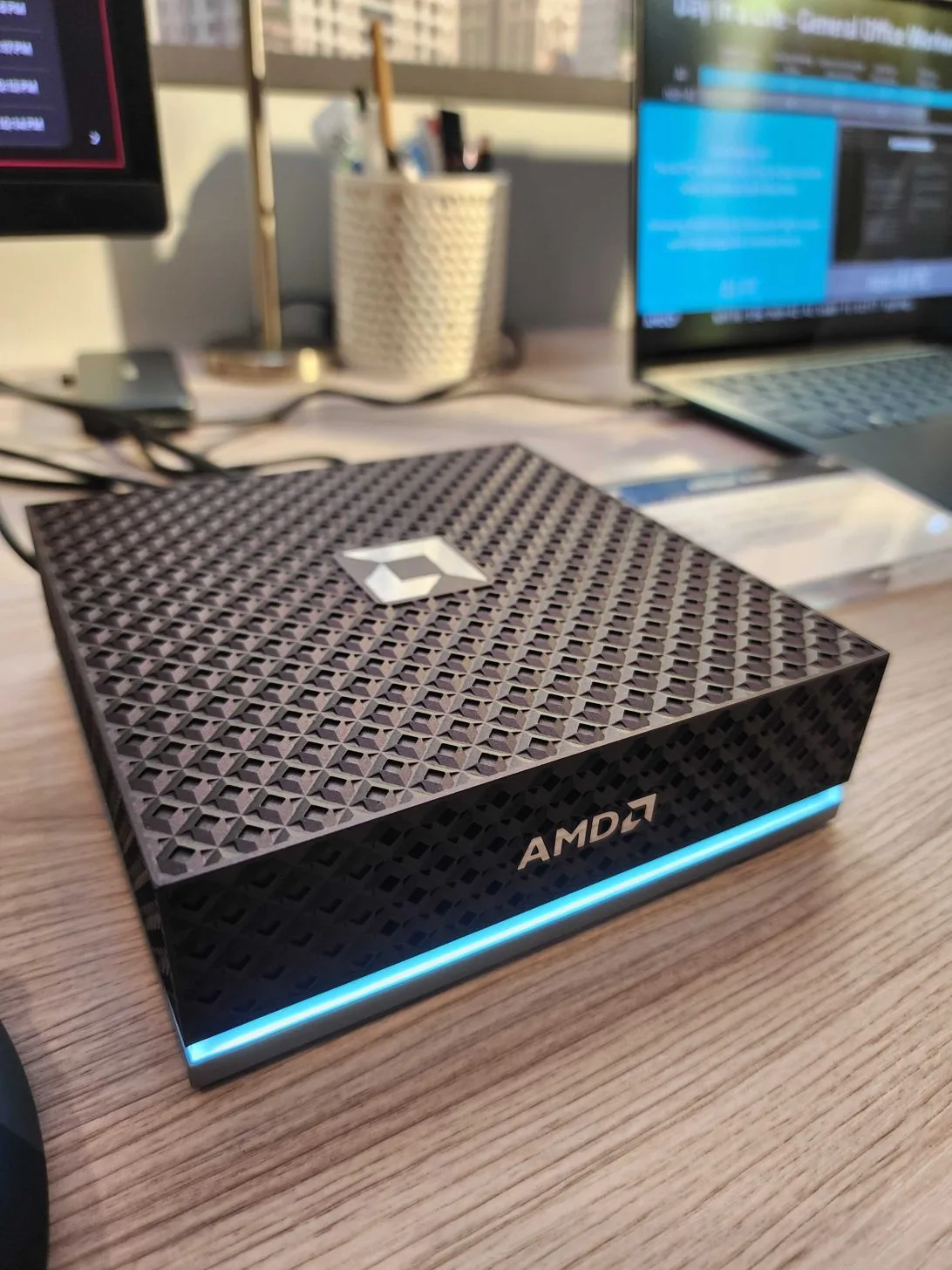
AMD's Ryzen AI Halo machine is one of the clearer signs that local AI hardware is moving from workstation towers into compact desk devices. The pitch is direct: give developers enough CPU, GPU, NPU, memory, and software support to run meaningful models locally without jumping straight to a cloud bill or a much more expensive dedicated AI box. That is a practical message for developers who want control over latency, data, and experiment cost.
The comparison with NVIDIA's DGX Spark is unavoidable because both products aim at people who need more than a normal laptop but do not want a full rack of infrastructure. AMD appears to be attacking the gap with price and platform flexibility. A compact AI PC that can run Windows or Linux has a different audience than a strictly appliance-like system. It can sit in a lab, a small studio, or a developer's home office and still behave like a general-purpose computer.
Wccftech reported the $3,999 pricing and the positioning against NVIDIA's higher-priced Spark system. That price difference is not everything, but it matters because AI developers often need more than one machine for testing, demos, or team access.
This story lines up with our broader look at local AI on existing PCs. The market is splitting in two directions at once. Some users want to reuse hardware they already own, while others want a compact box that is purpose-built for model work. Ryzen AI Halo sits in the second camp, but it benefits from the same trend: not every AI workload should automatically leave the desk.
The memory configuration is the key. Local models do not only need compute; they need enough shared memory to load and manipulate larger parameter counts without constant compromise. If AMD's platform gives developers a smoother path through PyTorch, vLLM, llama.cpp, ComfyUI, and local studio tools, the machine becomes less about a single benchmark and more about daily friction. Developers care about what runs, how fast it starts, and how often the toolchain breaks.
The launch also increases pressure on NVIDIA. DGX branding carries credibility, but smaller teams will compare cost, supported models, operating systems, and real workflow speed. AMD does not need to win every AI performance chart to make Ryzen AI Halo useful. It needs to make local experimentation feel affordable, repeatable, and powerful enough that developers think twice before sending every token to the cloud.
For AMD, the software promise may be more important than the box itself. AI developers have become skeptical of hardware launches that look impressive but require too much manual setup. If Ryzen AI Halo arrives with clear drivers, stable ROCm support, documented model recipes, and realistic examples, it can win time from its users. That is the scarce resource for small teams. They do not want to spend days finding a compatible build or discovering that a popular tool silently falls back to CPU. AMD has improved its developer story, but NVIDIA still benefits from habit and ecosystem gravity. A compact AI PC is a chance for AMD to prove that local AI work can be approachable on its stack. The hardware starts the conversation; the tooling will decide whether people keep using it.