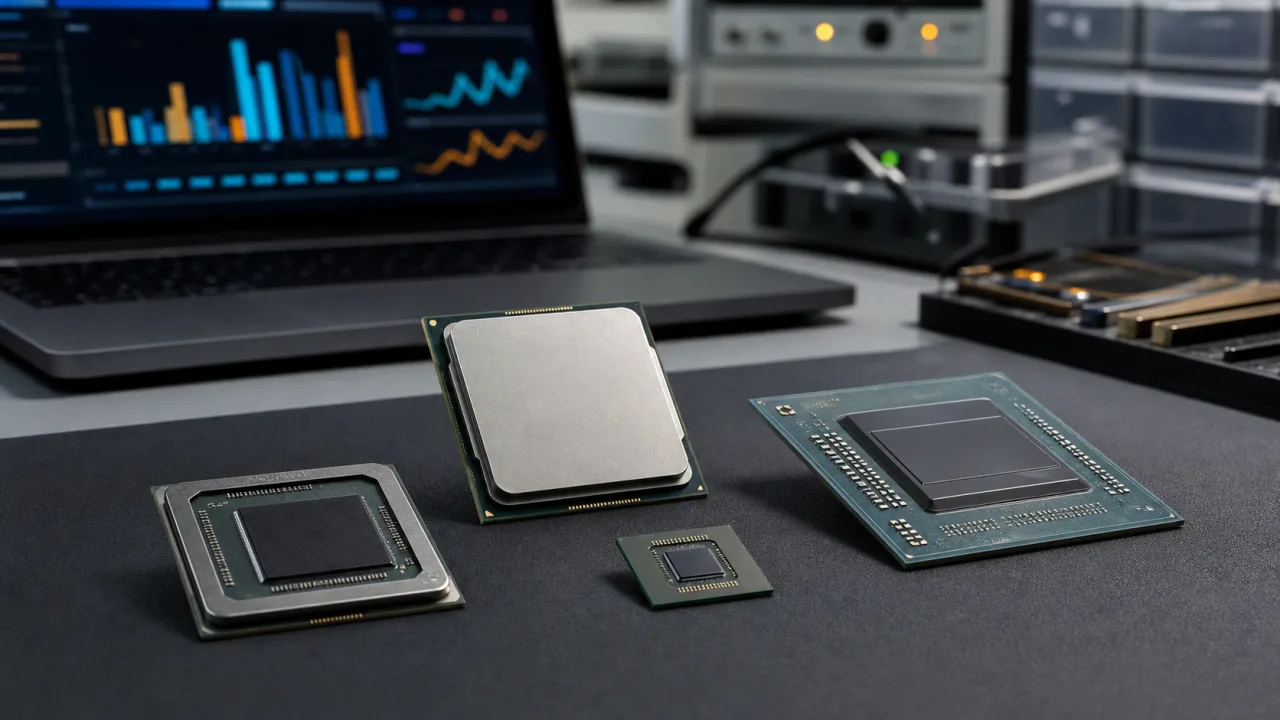
Benchmark leaks are useful only when they are read with restraint. A Geekbench, PassMark, OpenCL, or early vendor estimate can show that a chip is being tested in the open, but it rarely tells the final performance story. Engineering samples may be clocked far below retail silicon. Laptop chips may be running inside unfinished firmware. Phone SoCs can score high in a short test and still throttle under sustained load. That context matters more than the headline number.
The latest search across English hardware outlets and Chinese-language tech pages turned up a wide set of CPU and chipset benchmark reports covering AMD, Intel, Apple, Qualcomm, Samsung, and Nvidia. Some are true leaks from public benchmark databases. Some are alleged early listings. One AMD server result is an official estimate rather than a leak, but it belongs in the same conversation because it shows how vendors are now framing performance around racks and platforms, not only chips.
The strongest pattern is fragmentation. Desktop CPUs are leaning on cache and refresh tactics. Laptop chips are chasing battery-friendly performance and much stronger integrated graphics. Phone SoCs are pushing single-core numbers close to laptop territory. AI PC and Arm PC silicon are blurring the line between mobile chips and traditional notebook processors. That is why these leaks are more useful as a map of industry direction than as a buying guide.
AMD's early Zen 6 mobile entry is the easiest example of why caution is needed. A ten-core, 20-thread engineering sample identified around Medusa Point appeared with 32MB of L3 cache and very low clocks, reportedly scoring 1,210 in single-core and 7,323 in multi-core testing. Tom's Hardware linked the listing to AMD's next-generation laptop roadmap. The score itself is not impressive, but that is not the point. At this stage, the chip is a visibility marker: Zen 6 client silicon is moving through test systems, and the cache layout hints at where AMD may be tuning mainstream mobile performance.
AMD's gaming desktop story is louder. The alleged Ryzen 9 9950X3D2 leak points to a 16-core, 32-thread chip with 192MB of L3 cache, apparently by stacking 3D V-Cache across both CCDs instead of only one. Tom's Hardware cited an early Geekbench score of 3,456 single-core and 21,062 multi-core, with a separate PassMark listing reportedly reaching 71,585 multi-core points. If genuine, the interesting part is not only speed. It is AMD pushing cache capacity as a product identity, the same broad logic behind our earlier look at AMD Zen 6 server performance framing. More cache can help games and some creator workloads, but thermals, boost behavior, and scheduling will decide whether the dual-cache design feels meaningfully better in real systems.
The rumored Ryzen 7 9850X3D looks like the more practical chip. A Geekbench leak shows an eight-core part boosting around 5.6GHz and producing 3,439 single-core and 17,530 multi-core points on a Colorful B850M board with slow DDR5-4800 memory. A second lower listing also appeared, which makes sense for pre-release firmware. Tom's Hardware treated the numbers as promising but not decisive. The likely story is a mild frequency and tuning improvement over the existing X3D stack, not a completely new class of gaming CPU.
AMD's server-side Venice benchmark should be labeled differently. The public figures are not leaked retail scores; they are AMD's own rack-level estimates for Zen 6 EPYC Venice against Nvidia's Vera-related platform. Tom's Hardware summarized AMD's claim of a large performance advantage under a fixed 100kW rack budget, using internal scaling assumptions and external Grace data to model the comparison. That makes the result strategic, not independent. It still matters because AI infrastructure buyers increasingly care about system throughput, power, memory, networking, and accelerator feeding. Our coverage of AI chip manufacturing pressure shows why these platform-level claims are becoming central to the chip business.
Intel has several leaked benchmark stories running at once. Wildcat Lake, a low-power successor aimed at budget laptops, Chromebooks, compact PCs, and NAS-style devices, appeared through a Core 3 304 listing with 2,472 single-core and 6,708 multi-core points. That is a large jump over many current entry-level Intel chips, though the leaked configuration looked like an early engineering sample with incomplete core reporting. Tom's Hardware described it as a low-power part built around newer Intel core designs, and that is where the result is most meaningful: cheap machines may finally get a more modern baseline.
Panther Lake is more important for Intel's premium mobile reset. A Core Ultra 9 386H listing showed 2,849 single-core and 15,434 multi-core points in Geekbench, according to PC Gamer. Those numbers are respectable but not shocking against today's best mobile CPUs. The value of Panther Lake may instead come from the whole platform: updated process technology, improved efficiency, better integrated graphics, and AI PC features that need stable power behavior more than one spectacular benchmark run.
The Panther Lake graphics leak is more exciting. A Core Ultra X7 358H appeared in Geekbench OpenCL results with a 12-core Xe3 integrated GPU and a score reported around the low-to-mid 50,000 range, with later coverage pointing to roughly 57,000. That puts Intel's next integrated graphics in the neighborhood of lower-end discrete laptop GPUs in a short compute test. Tom's Hardware covered the earlier listing, and Chinese-language Sogou results also surfaced IT Home snippets about Core Ultra X7 358H benchmark exposure. If the retail driver stack holds up, thin laptops and handheld-style PCs could benefit more from this iGPU jump than from a small CPU score increase.
Intel's desktop refresh has also leaked through Geekbench. The Core Ultra 7 270K Plus, an Arrow Lake Refresh chip with 24 cores split between eight performance cores and 16 efficiency cores, reportedly scored 3,235 single-core and 21,368 multi-core points. Tom's Hardware framed that as a modest improvement over the Core Ultra 7 265K, and the result tells a practical story. Intel appears to be using extra E-cores, memory support, and platform tuning to make LGA 1851 more attractive while it waits for a larger architectural move. That fits the same motherboard-roadmap tension behind our coverage of the Intel Z990 chipset leak.
Qualcomm's phone benchmark leaks are much more dramatic on paper. Snapdragon 8 Elite Gen 5 appeared in a Xiaomi device listing with a reported Geekbench single-core score of 3,831. That puts it close to Apple's newest high-end phone silicon and ahead of many desktop chips in single-threaded Geekbench comparison. Tom's Hardware tied the listing to an unnamed Xiaomi model, while Sogou search results in Chinese showed video and news snippets around Xiaomi 17 Pro and Snapdragon 8 Elite Gen 5 benchmark claims. The obvious warning is thermals. A flagship phone can deliver a stunning burst score and still behave very differently after ten minutes of gaming or camera processing.
The non-Elite Snapdragon 8 Gen 5 leak is just as important because it shows Qualcomm building a more layered flagship stack. Android Central reported a Motorola Edge 70 Ultra, or China-market Moto X70 Ultra, listing with Snapdragon 8 Gen 5, Adreno 829 graphics, 16GB of RAM, Android 16, and Geekbench scores of 2,636 single-core and 7,475 multi-core. Android Central noted the 2+6 CPU layout and lower positioning below the Elite chip. That suggests Qualcomm wants a high-end-but-not-ultra tier for phones that need strong performance without the most expensive silicon.
Qualcomm's PC ambition showed up separately through Snapdragon X2 benchmark leaks. PC Gamer reported that a Snapdragon X2 Elite Extreme result reached around 4,080 single-core and 23,491 multi-core points, while other coverage compared Apple's M5 MacBook Pro leak at 4,263 single-core and 17,862 multi-core. PC Gamer framed the result as a major Arm PC warning to x86 laptop chips. The multi-core number is especially aggressive, but software compatibility, sustained power, and OEM cooling will decide whether it becomes a real Windows laptop threat.
Samsung's Exynos 2700 leak is less numeric but still worth tracking. Alleged performance data points to a 10-core design, a fastest core around 2.88GHz, and an Xclipse 970 GPU, with rumor chatter suggesting an overall uplift over Exynos 2600. Android Central was careful about the source quality, and that caution is right. Samsung needs Exynos to be competitive not only in peak scores but in modem behavior, battery life, image processing, and regional Galaxy pricing. A better early score would help the story, but Samsung's real test is consistency.
Apple remains the single-core benchmark target. A presumed M5 iPad Pro listing, identified as iPad 17,3, reportedly produced a 4,133 single-thread score in Geekbench with a nine-core CPU running up to about 4.42GHz and 12GB of RAM. Tom's Hardware described the result as a strong jump over the 14W M4 generation. A separate M5 MacBook Pro benchmark leak, covered by TechRadar, adds another angle: Apple's advantage may remain single-thread and efficiency, while Qualcomm chases higher multi-core scores in larger PC designs.
Apple's A19 Pro phone result also belongs in the same benchmark conversation. Early Geekbench results put the chip around 3,895 single-core and 9,746 multi-core, with a six-core layout and high peak clocks. Tom's Hardware compared the single-core result against desktop-class CPUs, which is impressive but easy to overread. A phone chip winning a short single-thread test does not mean it replaces a desktop CPU. It means Apple has kept its per-core design lead in a power envelope that still forces strict thermal control.
Nvidia's leaked N1X SoC is a different kind of chip story. The listing described a 20-core Grace CPU arrangement paired with a Blackwell-class integrated GPU configuration with 6,144 CUDA cores, but the early Geekbench OpenCL score of 46,361 was modest because the sample reportedly ran around 1.05GHz. Tom's Hardware noted that the silicon and drivers are clearly unfinished. The more important implication is Nvidia exploring client or workstation-style Arm systems with a much stronger local GPU story, a theme that connects to our earlier piece on Nvidia laptop chips and local AI.
Chinese-language pages add useful context because many Geekbench leaks circulate quickly through Chinese tech media before they are repeated elsewhere. ZOL published a Chinese report in October 2024 on M4 Mac Geekbench results, citing a Mac16,1 test machine with a 10-core CPU, 3,864 single-core points, 15,288 multi-core points, and a Metal score of 57,603. That is not a fresh 2026 leak, but it shows how Apple silicon benchmark visibility tends to appear ahead of product announcements and then shape buyer expectations.
Another Chinese-language example came from Sina Finance, which republished IT Home coverage of AMD Ryzen AI 9 HX 370 Geekbench 6 results in June 2024. The report cited an ASUS ProArt 16 machine reaching 2,833 single-core and 14,773 multi-core points, while a thinner ASUS laptop scored 2,795 and 14,124. Again, this is historical context rather than a new 2026 leak, but it is directly relevant because it shows the same pattern now repeating with Panther Lake, Snapdragon X2, and M5: thin-and-light processors are being judged by benchmark leaks months before broad retail testing.
The safe read is that benchmark leaks are no longer isolated enthusiast trivia. They are part of how chip roadmaps become public before launch. AMD is using cache and rack-scale framing. Intel is trying to rebuild mobile and desktop credibility. Apple is still pushing per-core performance. Qualcomm is attacking phones and PCs at once. Samsung needs Exynos consistency. Nvidia is experimenting with Arm-plus-GPU systems that could reshape local AI devices. None of these leaks should be treated as final review data, but taken together they show a semiconductor market where performance claims now start leaking long before products reach shelves.
For buyers, the next step is patience. Wait for retail hardware, final firmware, sustained workload tests, battery measurements, and thermals. For the industry, the message is already clear: the benchmark race is no longer just desktop CPU versus desktop CPU. It now spans phones, tablets, laptops, AI PCs, handhelds, workstations, and server racks, all competing for attention with numbers that look simple but require careful reading.