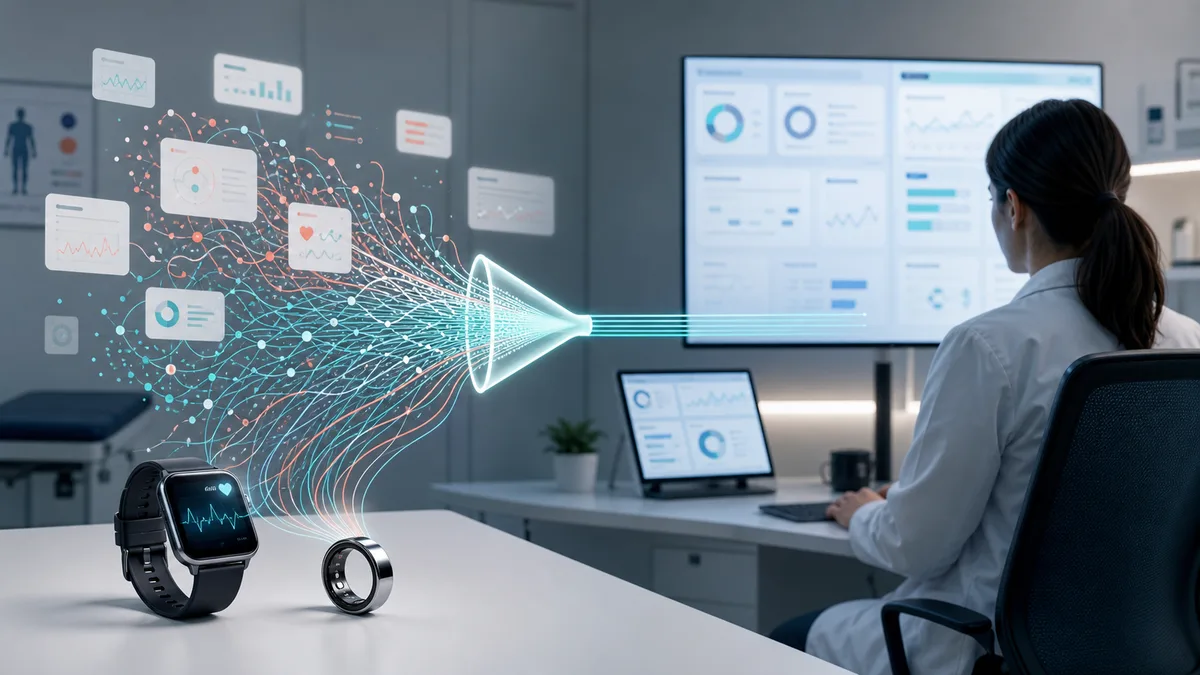
Wearable health devices have succeeded at collecting data. The harder question is what to do with it. Heart rate, sleep, temperature, oxygen, activity, stress, and recovery metrics can be useful, but a doctor's day does not get longer because patients generate more numbers. More data can become more burden if it arrives without context.
This is where clinical AI has a real job. The best use of AI in wearable health may not be dramatic diagnosis. It may be filtering, summarizing, prioritizing, and explaining which signals deserve attention. A system that reduces noise can be more valuable than one that produces another dashboard.
The risk is that consumer health data looks precise while being difficult to interpret. A watch can detect a trend, but clinical meaning depends on history, symptoms, medications, device accuracy, and whether the measurement was taken correctly. Doctors need usable summaries, not raw streams that create liability without clarity.
ZDNet reported that the wearable health boom is creating data overload for doctors and asked what happens next. The important point is that patients have more information than ever, but much of it is not yet useful in a clinical workflow.
This connects with broader AI trust problems, including our AI search liability coverage. In both cases, AI systems must turn information into guidance without pretending uncertainty has disappeared. Health data makes that responsibility even more sensitive.
For patients, wearable data can still be valuable. It can reveal patterns, encourage healthier routines, and help people notice changes. The problem begins when every variation becomes a medical question. A good system should separate ordinary fluctuation from trends that may require follow-up.
Clinics will need workflow design. Data should enter electronic health records only when it is relevant, consented, and presented in a form clinicians can act on. Otherwise, doctors may ignore it, patients may feel dismissed, and health systems may carry extra documentation risk.
Wearables have created a measurement boom. The next phase needs interpretation discipline. AI can help if it becomes a filter that respects clinical context, patient privacy, and human judgment. If it simply adds more alerts, it will turn a promising health trend into another source of digital fatigue.
The commercial opportunity is real, but it should be approached carefully. Health systems do not need another app that turns every sleep dip or heart-rate spike into a notification. They need triage logic that understands baseline behavior, clinical relevance, and when a human professional should be involved. That requires validation, not only attractive visualizations. Device makers, AI vendors, and hospitals will have to decide who is responsible when data is ignored, overinterpreted, or poorly explained. The winning products may be the quiet ones that reduce unnecessary appointments, highlight meaningful changes, and give clinicians concise summaries they can trust during a short visit.
The next digital health winners will probably be measured by how little noise they create. A system that helps doctors ignore irrelevant data may be more valuable than one that captures another thousand signals.
In healthcare, less noise can be the real innovation.