BMW M's Neue Klasse concept shows how performance cars are changing as electric platforms mature. The traditional performance formula was built around engines, transmissions, exhaust character, and mechanical traction. Electric performance shifts the center of gravity toward software, power electronics, battery architecture, and motor control. BMW is clearly trying to preserve the emotional identity of M while admitting that the technical foundation has changed.
The concept uses four motors, a 100kWh battery, 800V architecture, and BMW's Heart of Joy central computer to manage drive and braking at each wheel. That last point is the most important. Four motors create the potential for extremely precise torque control, but the advantage only appears if the car can coordinate them quickly and predictably. The software layer becomes the performance differential. It decides how the car rotates, recovers energy, responds to throttle input, and keeps traction under load.
EV performance is therefore becoming less about one headline horsepower number and more about integrated control. That is true across the car industry, where charging, driver assistance, thermal management, and chassis behavior increasingly depend on centralized compute. We have covered similar software-defined vehicle pressure in broader device and compute architecture shifts, where hardware value depends on the intelligence coordinating it.
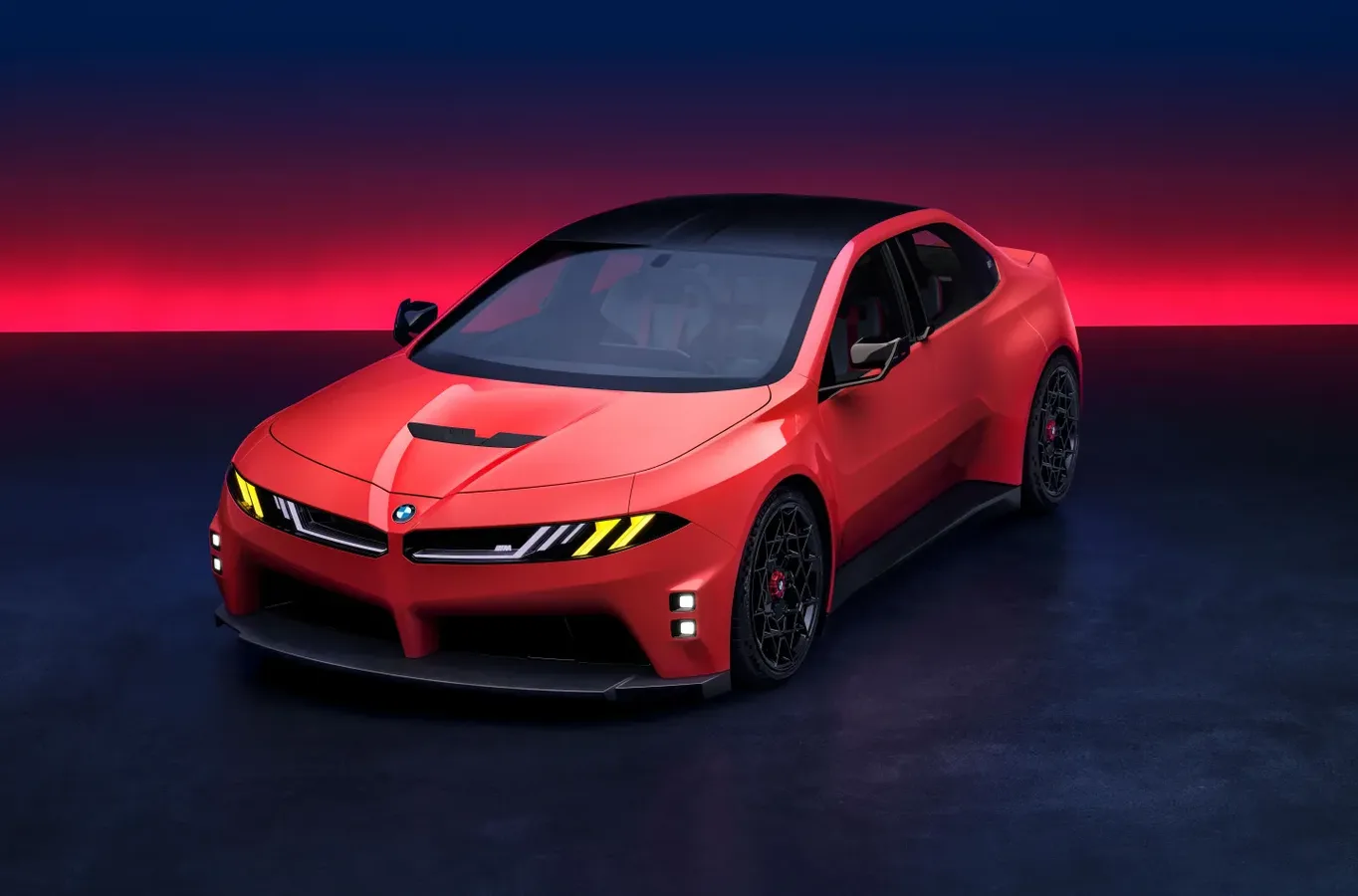
IT Home reports that the concept debuted before the Le Mans event and is based on BMW's Neue Klasse next-generation architecture. The report highlights M yellow lighting, three-dimensional Track Lights, a V-shaped cooling vent, natural-fiber bucket seats, a roll cage, four-motor M eDrive, 800V fast-charging support, and sixth-generation cylindrical battery cells.
The design language is also doing work. BMW needs future M cars to look electric without becoming anonymous. Wider arches, a stronger shoulder line, a ducktail spoiler, and aero-focused rear elements are ways to connect the concept to racing tradition. The cabin, with bucket seats and track-focused materials, reinforces that this is not just a luxury EV with quick acceleration. It is meant to signal a performance tool.
The question is how much of this concept reaches production. Four-motor systems are expensive, heavy, and complex. A 100kWh pack can support high output, but it also adds mass that engineers must hide through chassis tuning and energy recovery. BMW's challenge will be making the car feel like an M product rather than a fast computer on wheels. If the Heart of Joy controller delivers the direct response BMW is promising, the Neue Klasse M direction could show how enthusiast EVs mature: not by imitating combustion, but by making software control feel mechanical, immediate, and trustworthy.
There is also a branding challenge. Many performance EVs are already extremely quick in a straight line, so acceleration alone no longer defines specialness. BMW M has to make control, endurance, braking feel, cooling consistency, and driver feedback part of the story. The Neue Klasse concept suggests BMW understands that the next performance fight is about repeatability and precision. A car that delivers one explosive launch is less impressive than one that remains sharp lap after lap.