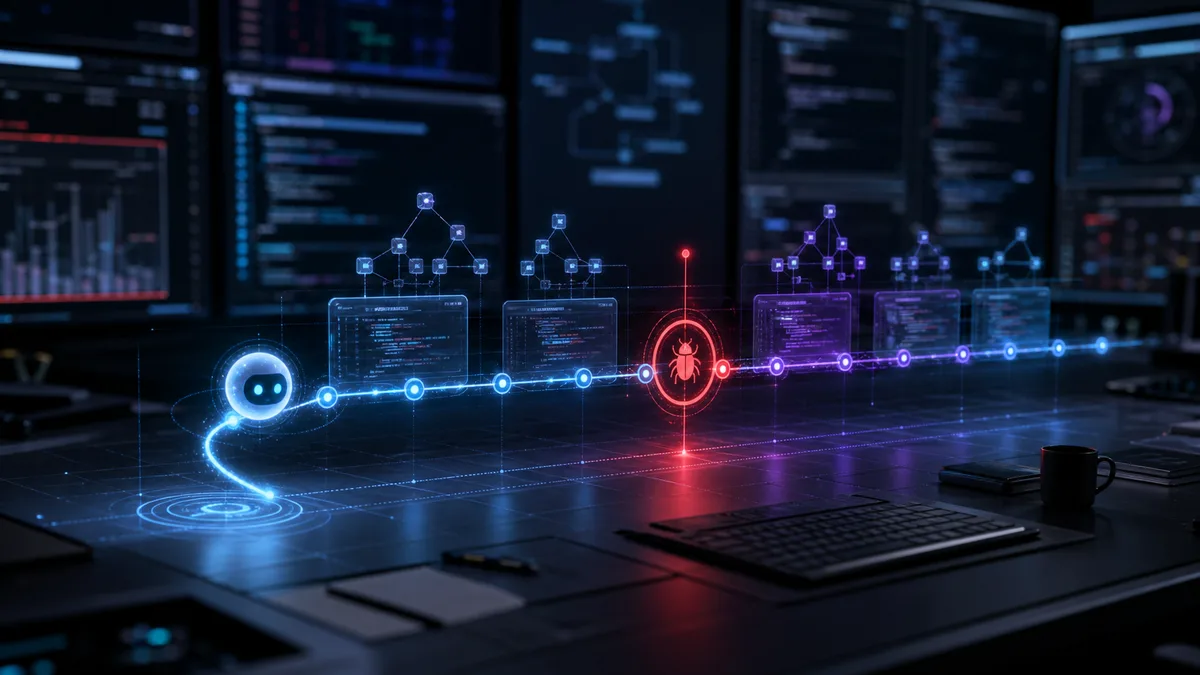
AI coding agents are improving quickly, but they still struggle with one of software engineering's most important realities: bugs happen at runtime. A model can inspect files, summarize code, and suggest patches, yet still miss the exact state transition that causes a failure. Without runtime context, debugging becomes guesswork with better grammar.
This is why runtime memory is becoming valuable. Developers do not fix complex bugs only by reading source files. They inspect traces, reproduce failures, examine variables, compare expected and actual behavior, and understand how the system moved through time. An AI agent needs access to that same evidence if it is going to be more than a code completion tool.
The next generation of coding agents will likely combine repository understanding with execution history. That means stack traces, logs, recordings, test runs, performance counters, and user steps could become part of the agent's working context. The agent may still write code, but the important part is how it decides what code to write.
SiliconANGLE reported that Undo raised 37 million dollars to give AI agents runtime context for fixing bugs. The funding is notable because it targets a practical bottleneck in AI-assisted development rather than another general coding interface.
The benchmark side of this problem appears in our Gemini-SQL2 text-to-SQL article. Enterprise AI tools need to be correct in operational contexts, not just fluent. For coding agents, correctness depends on understanding execution, tests, and failure modes.
Runtime-aware agents could also change developer workflows. Instead of asking an assistant to guess why a test failed, a developer might provide a recorded failure path and ask the agent to identify the smallest relevant change. That would make the tool feel less like autocomplete and more like a junior engineer with a debugger open.
There are risks. Recording runtime context can capture sensitive data, secrets, customer information, or proprietary behavior. Any product in this space needs strong redaction, access controls, and clear retention policies. Better debugging is not worth creating a new data leak channel.
Undo's round shows where AI coding is heading. The next fight is not only who writes the best function from a prompt. It is who can understand a live system well enough to make safe changes. In real engineering teams, that is the difference between a clever assistant and a tool people trust in production.
There is a broader change in developer-tool competition here. The first wave of AI coding assistants was judged by how often they could produce useful snippets. The next wave will be judged by how well they understand systems already in motion. Runtime context, replay, tracing, and failure memory can turn the agent from a writer into an investigator. That matters because many expensive engineering problems are not blank-page problems. They are problems where the code mostly works until a rare state, race, input, or dependency breaks it. Tools that can preserve and reason about that history will be much harder to replace than generic prompt boxes.
That is the kind of capability that can survive after the novelty of AI coding fades. Teams will keep tools that reduce investigation time and remove uncertainty from difficult bugs.